

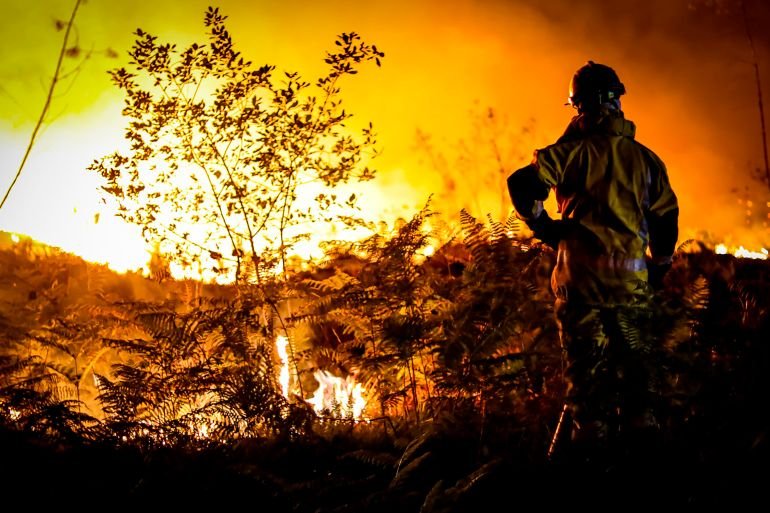
A massive wildfire that has been in the top ten of recent wildfire tragedies has swept southern Europe with fatal fires raging across Türkiye, Greece, and Cyprus. It is now established by scientists that the climate change caused by humans was ten times more prone to extreme weather conditions behind these fires making the Mediterranean summer a season of firestorms.
Human Toll and Destruction
The fires have caused a sad human toll. In Türkiye, at least 17 people died, of which 10 of them were trapped in fast moving winds in Eskişehir, are firefighters. Hundreds of thousands of inhabitants and tourists had to escape. Fires destroyed homes, farmland and holiday resorts and evacuated 32,000 individuals in Greece, among whom 5,000 were tourists on Crete. Cyprus had the most devastating wildfire in decades and two villagers were killed as they fled Monagri and close to 125 square kilometers or 1 percent of the island was reduced to ashes.
Wildfires in Türkiye
Turkiye had one of the hardest summers in its history. The General Directorate of Forestry reported that 612 forest fires broke out in June, and then 624 at the beginning of July. In July alone, satellite data of the MODIS identified 177 wildfires that ravaged 60,000 hectares of land. Hardest affected provinces were Izmir, Bursa, Çanakkale, Manisa, Bilecik and Hatay. There were also mass evictions in Izmir and Bursa where the flames came to the edges of city and threatened city centers and forest villages. Overall, 50,000 individuals were evacuated in the country.
What aggravated the situation was the presence of Calabrian pine forests, a tree species in which the cones explode when fire strikes, thereby spreading seeds, but also allowing the fire to spread. By contrast, fire was mostly caused by stubble burning of agricultural lands in southeastern Türkiye.
Flames Across Greece
Greece had to withstand one of the harshest wildfire seasons in its history. Fire engulfed the suburbs of Attica, Crete, Evia and Kythera and tens of thousands were displaced. On Kythera half the island had been reduced to ashes, and in Crete there had been an entire destruction of resorts, and of farms. The firefighters who were injured in the fires were thirteen as crews were overwhelmed in the fire, which disrupted daily life and tourism.
The devastation that occurred in July did not stop new outbreaks in Greece in August. BBC reports indicate that five huge fires had burned around 19,800 hectares, including 7,200 hectares of Chios island (12 August), 3,200 hectares of the area around Patra (15 August), 1,500 hectares of East Attica, Lavrio (8 August), 2,500 hectares of Zakynthos (15 August), and 5,200 hectares of Preveza, Ipiros (12 August).
Cyprus: A Small Island, Big Losses
North of Limassol, there was a massive destruction of Cyprus. The area of fire was indiscriminate with its limited space: 14 villages were evacuated, two individuals were killed, and 1 per cent of the island was burned down. Aerial firefighting support was very essential in combating blaze in this country.
Why These Fires Were So Extreme
The event was researched by an international group of scientists (Türkiye, Greece, Netherlands, Sweden, Denmark, the US and UK) and evaluated the severity of fire weather and drought conditions. Their results point directly to the climate change:
Cumulative Daily Severity Rating (DSR), the measure of the difficulty in fire suppression, indicated that these conditions are now taking place after every 20 years in the 1.3 o C warmer climate today five times more frequently than in a cooler past climate. These conditions would have only happened once during 100 years without climate change.
Similar findings were confirmed by Vapour Pressure Deficit (VPD7x), indicating how the dry air that is heated by climate change dries vegetation: in the current climate it would have occurred once every 10 years, but in the absence of climate change, once every 100 years.
According to climate models, even a greater effect exists: VPD7x is 13 times more probable and 18 percent more severe, and DSR is 10 times more probable and 22 percent more severe because of human caused warming.When we increase global warming to 2.6C, as policies are currently projected to cause, we will see more danger of wildfires:
VPD7x: 18% more intense and six times more likely than now.
DSR: 25% more intense and nine times more likely.
Changing Weather Patterns
The northerly winds and high-pressure ridges, which propagated fires so rapidly, were investigated by researchers, as well. The 19942023 climate is characterized by increased high pressure systems and warmer winds relative to 19511980, a climate similar to the drastic arrangement of 2025.
Previous rain trends contribute to the risk: Greece experienced a dry winter and Turkiye had wetter conditions, but in the last several decades, the total rainfall decreased by 14% on average, contributing to drought and stress of vegetation. In the Fire Weather Index, the drought code rated 2025 among the driest years in history.
Strain on Firefighting and Adaptation Efforts
The fires have challenged the European emergency systems. It was the first summer in which the EU Civil Protection Mechanism was activated 17 times to aid Greece, Turkiye, Albania, Bulgaria and Spain in a span of one week. Concurrent mega-fires spread over the continent are placing firefighting forces under an ever-growing strain.
Governments are responding
Turkiye has developed air corps, fire detection AI, and volunteer corps.Greece has unleashed drones and special fire teams.Cyprus has resorted to the satellite method of detection.Gurus emphasize that adaptation should not be limited to technology. Education on fire management, investment in proactive fire management, and incorporation of Indigenous, traditional and contemporary practices have been considered to be key to future resilience.
The Bigger Picture
The 2025 wildfires point out to a threatening reality, which is living in a world that is already warmed by at least 1.3 C, extreme fire seasons are no longer an exception, but a new norm. When the Mediterranean is trying to meet the demands, the fires of Turkiye, Greece, and Cyprus act as a reminder of the future of the even warmer world.