
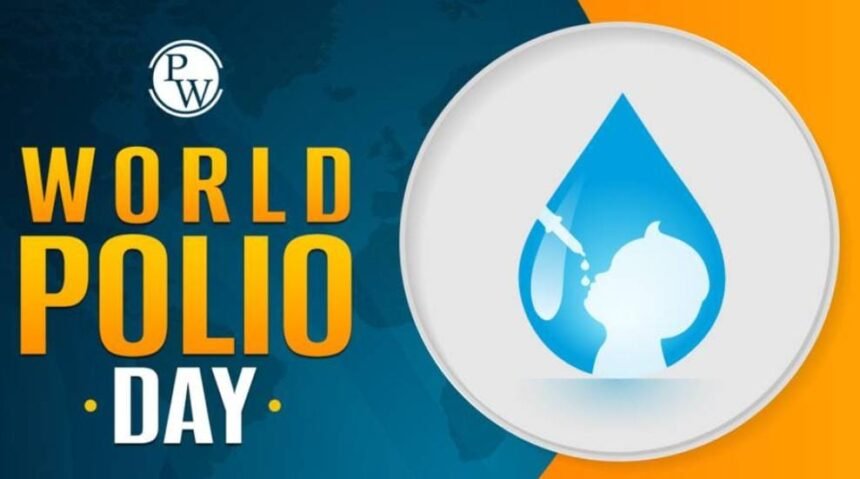
ISLAMABAD/KARACHI: The world marks World Polio Day 2025 with renewed determination to eradicate one of the most persistent and devastating viral diseases in human history. As global vaccination efforts continue to bring the world closer to zero cases, Pakistan—one of only two countries where wild poliovirus remains endemic—reaffirmed its national resolve to protect every child through continued immunization and awareness.
Polio, or poliomyelitis, is a highly infectious viral disease that mainly affects children under five years of age. The virus invades the nervous system and can cause total paralysis within hours. Transmission occurs primarily through the faecal-oral route, or occasionally through contaminated food and water.
Early symptoms include fever, fatigue, headache, vomiting, neck stiffness, and limb pain. According to the World Health Organization (WHO), one in every 200 infections leads to irreversible paralysis, and up to 10% of those affected die when their breathing muscles become immobilized.
Global progress and remaining challenges
Since the launch of the Global Polio Eradication Initiative (GPEI) in 1988, cases of wild poliovirus have decreased by more than 99%, dropping from 350,000 annual cases across 125 countries to just two endemic countries—Pakistan and Afghanistan.
Despite this remarkable progress, experts emphasize that as long as one child remains infected, children everywhere remain at risk. Failure to eliminate polio from the remaining strongholds could lead to a global resurgence of the disease.
There is no cure for polio, but it can be prevented through vaccination. The oral polio vaccine (OPV) and the inactivated polio vaccine (IPV) remain the cornerstone of global eradication strategies. WHO stresses that continued vaccination, surveillance, and cross-border coordination are critical to achieving lasting eradication.
Globally, more than 20 million people are able to walk today who would otherwise have been paralyzed, and an estimated 1.5 million childhood deaths have been prevented through vitamin A supplementation during immunization campaigns.
Polio workers lauded as real heroes in Pakistan’s fight against virus
Sindh Minister for Health and Population Welfare Dr. Azra Fazal Pechuho has lauded polio workers as the true heroes of Pakistan’s fight against the virus, praising their tireless door-to-door efforts to administer drops to children despite challenging circumstances.
Speaking at a graceful ceremony organized by the Emergency Operations Centre (EOC) for Polio Eradication Sindh at the Jinnah Postgraduate Medical Centre (JPMC), Karachi, to mark World Polio Day 2025, Dr. Pechuho reaffirmed that polio eradication remains the government’s top priority and a national responsibility.
She expressed her firm resolve to make Sindh a polio-free province by 2026, paying tribute to polio workers, Deputy Commissioners (DCs), and District Health Officers (DHOs) for their dedication.
“If the same level of commitment and cooperation continues, we will, God willing, make Sindh a polio-free province by 2026,” she said. “Polio workers serve humanity selflessly, often at great personal risk.”
Dr. Pechuho appealed to parents to ensure their children receive polio drops during every campaign.
“Children with weaker immunity are more vulnerable to the virus. Parents must understand that even apparently healthy children can be affected,” she emphasized. “It is the duty of every parent to protect their children by ensuring they are vaccinated so that no child remains unprotected.”
Pakistan’s renewed commitment on World Polio Day
On World Polio Day 2025, First Lady Bibi Aseefa Bhutto Zardari reaffirmed Pakistan’s unwavering resolve to eliminate polio once and for all. She said that while the country has made significant progress, “each child missed is a child at risk.”
Recalling the legacy of Shaheed Mohtarma Benazir Bhutto, who launched Pakistan’s first nationwide polio eradication campaign in 1994, the First Lady noted that her mother personally administered the first polio drops to her—a moment that shaped her lifelong commitment to the cause.
She paid tribute to health workers, security personnel, and especially women vaccinators who continue to serve in challenging conditions to ensure no child is left behind. “Their courage and sacrifice have brought Pakistan closer to a polio-free future,” she said.
Emphasizing community participation, Bibi Aseefa Bhutto Zardari urged parents, caregivers, and local leaders to support vaccination efforts, saying that the dream of a polio-free Pakistan can only be achieved through unity and persistence.
Why polio eradication matters
Ending polio is not only a health priority but a moral responsibility to future generations. Once eradicated, polio will become only the second human disease in history—after smallpox—to be completely eliminated.
Economic models estimate that global eradication would save at least USD 40–50 billion, mostly in low-income countries, while strengthening public health infrastructure for broader disease surveillance and immunization programs.
A polio-free world would mean no child will ever face the lifelong consequences of paralysis again—a testament to international cooperation, scientific progress, and human resilience.