
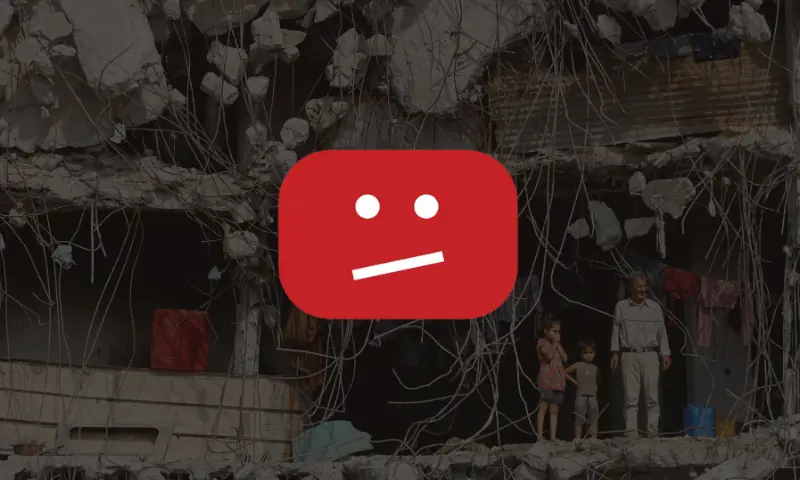
YouTube has quietly taken down hundreds of videos uploaded by Palestinian human rights organizations that documented alleged Israeli war crimes in Gaza, sparking outrage among activists and digital rights groups who accuse the platform of silencing crucial evidence.
According to an investigation by The Intercept, YouTube removed over 700 videos and terminated the channels of three prominent Palestinian human rights groups — Al-Haq, Al-Mezan Center for Human Rights, and the Palestinian Centre for Human Rights (PCHR).
These organizations have for years been archiving visual evidence of civilian casualties, bombed hospitals, and destroyed neighborhoods — content they say is vital for global accountability.
“This is not just content — this is evidence,” said a spokesperson for Al-Haq. “By erasing these videos, YouTube is effectively helping to hide the truth about what’s happening in Gaza.”
YouTube’s defense: “Legal compliance”
YouTube, which is owned by Google, acknowledged that it had taken down the content but said the move was a matter of legal compliance, not censorship. The company cited U.S. sanctions laws that restrict services to certain entities and regions, suggesting it was obliged to remove the accounts under those rules.
However, critics argue that this explanation doesn’t hold up — because the content wasn’t promoting violence or terrorism, but documenting the aftermath of military attacks.
Digital rights experts warn that this kind of automated or blanket enforcement has far-reaching consequences. “When platforms remove human rights documentation, they’re not just deleting videos — they’re erasing evidence that could one day be used in international courts,” said Marwa Fatafta, a digital rights advocate with Access Now.
“Censorship in the name of compliance”
The move has triggered backlash from rights groups, journalists, and academics worldwide. They accuse YouTube of hiding behind technical jargon while enabling digital erasure of Palestinian suffering.
The Palestinian Centre for Human Rights said in a statement that YouTube’s decision “strips Palestinians of their right to record their own history and share their lived reality.”
Some observers say this isn’t an isolated case. Over the past year, social media companies — including Meta’s Facebook and Instagram — have been repeatedly accused of suppressing Palestinian voices, often under vague “policy” or “safety” justifications.
Larger implications for online evidence
The timing is especially sensitive. As investigations into alleged war crimes in Gaza intensify, human rights organizations have relied heavily on online archives and open-source evidence to build cases.
Removing these videos could cripple that work. “Platforms have become part of the battlefield — not in the military sense, but in the information war,” said an independent researcher who works on digital evidence collection. “Deleting this footage is like destroying a crime scene.”
YouTube has not publicly disclosed whether it preserved the removed material for potential legal use or if the deletions are permanent. That lack of transparency adds to fears that vital records could be lost forever.
A recurring pattern
This isn’t the first time YouTube’s moderation practices have drawn criticism. In recent years, the platform’s algorithms have flagged and removed footage from Syria, Yemen, and Myanmar that human rights investigators considered crucial evidence.
At the heart of the issue is a fundamental question: Who controls the historical record when global platforms act as both archivists and gatekeepers?
Rights advocates say that by prioritizing “compliance” over context, YouTube risks aligning with powerful states while erasing the digital footprint of victims.
As one activist put it bluntly:
“When Silicon Valley decides what the world gets to see, justice becomes optional.”