A senior US congressman has cautioned that rapid advances in military technology could heighten the chances of a dangerous “misunderstanding” between American and Chinese forces, urging deeper dialogue to prevent conflict.
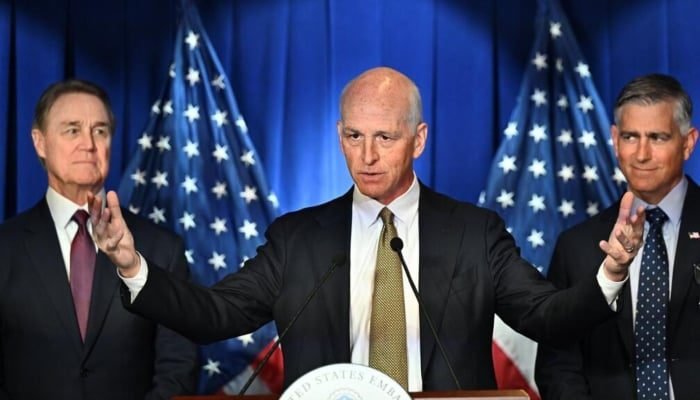
Speaking at a press conference in Beijing on Tuesday, US Representative Adam Smith, the ranking Democrat on the House Armed Services Committee, said China must engage more openly with global powers about its military operations.
“We’ve seen our ships and planes coming entirely too close to theirs,” Smith warned. “We need to have a better conversation about de-conflicting these things.”
Smith is leading a bipartisan four-member congressional delegation, which includes fellow Armed Services Committee Democrats Ro Khanna and Chrissy Houlahan, as well as Republican Representative Michael Baumgartner, a member of the House Foreign Affairs Committee. The group is in Beijing for a series of high-level meetings.
Calls for removing “disruptive factors”
On Monday, the delegation met with Chinese Defence Minister Dong Jun, who stressed the need to “remove disruptive and restrictive factors” in US-China ties, according to state-run Xinhua. The US side said the discussions highlighted the importance of more candid dialogue and managing differences.
Smith, joined by US Ambassador to China David Perdue, also flagged concerns over AI, drones, cyber, and space technologies, noting that innovation in warfare is advancing at breakneck speed. “The risk of misinterpreting capabilities on one side or the other is great,” he said, stressing the urgency of clear communication to avoid accidental conflict.
Trade, tariffs, and TikTok on the table
The visit comes shortly after a phone call between US President Donald Trump and Chinese President Xi Jinping, their second since Trump’s return to the White House. Both leaders signaled plans to meet on the sidelines of the upcoming APEC summit in South Korea, with reciprocal visits to follow.
The two countries recently eased a bitter tariff dispute, though current duties remain steep — 30% on Chinese goods entering the US and 10% on US products bound for China. The agreement expires in November, and trade talks are ongoing.
Smith’s delegation also met Chinese Vice Premier He Lifeng to discuss critical economic issues, including fentanyl trafficking, rare minerals, and the future of TikTok. Washington has proposed a localized version of the app, with a US-based algorithm, as a possible compromise to keep the platform running domestically.
“My understanding is that I don’t think that has been 100% resolved,” Smith said when asked about TikTok.
The lawmakers are also scheduled to meet NPC Chairman Zhao Leji and Foreign Minister Wang Yi later this week, as Washington and Beijing attempt to manage tensions across security, technology, and trade.