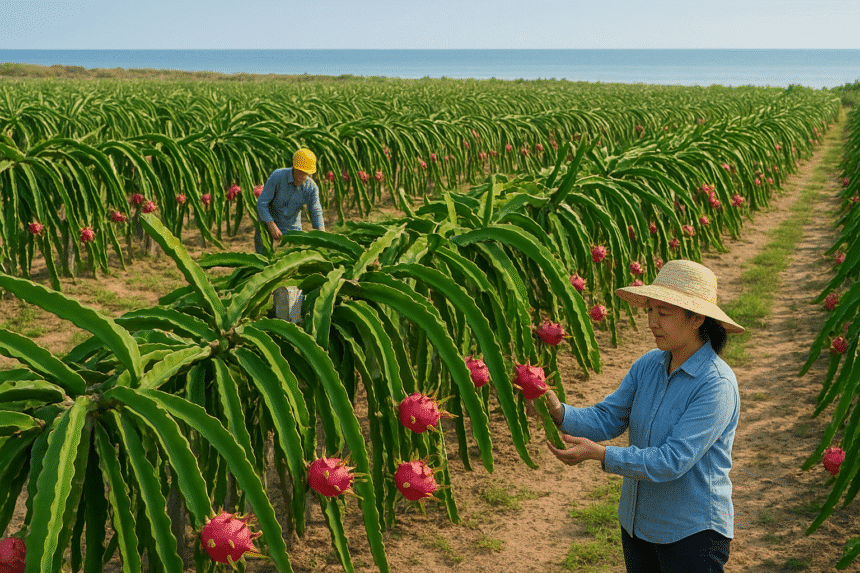
KARACHI: A landmark Pakistan-China agricultural collaboration has successfully transformed barren coastal land near Karachi into flourishing dragon fruit farms, marking a major step in sustainable land rehabilitation and high-value crop production.
Four years ago, Tiantian Farm a Chinese agricultural enterprise joined hands with another Chinese firm and three Pakistani partners to reclaim 48 hectares of saline and alkaline soil, just three kilometres from the Arabian Sea. Using modern Chinese land restoration techniques, the once-unusable terrain has now become fertile ground for premium dragon fruit cultivation.
At present, Tiantian Farm is growing dragon fruit on 20 hectares, with plans to expand by another five hectares every few months. During harvest seasons, nearly 50 local workers are employed, boosting rural incomes and providing valuable agricultural training.
The farm’s produce including popular varieties such as hongxin (red flesh), bairou (white flesh), huanglong (yellow), Jindu, and Dahong 3 is now available in supermarkets and specialty stores across Pakistan. The fruit is also gaining traction in Pakistan’s beverage market, especially in bubble tea outlets.
Beyond production, Tiantian Farm operates an eight-hectare base in Lahore and supports farmers by distributing saplings, training cultivators, and promoting scientific research. Recently, students from the University of the Punjab’s Centre of Excellence in Molecular Biology visited the Karachi site to study the farm’s innovative cultivation methods.
The company is also testing export potential, sending samples to buyers in the Middle East, Africa, Europe, and Central Asia where early feedback has been promising. Plans are underway to explore value-added products like dragon fruit juices and dried snacks, which could enhance Pakistan’s export portfolio and open new revenue streams.
Local farmers in Sindh are also joining the trend. Captain Rizwan Rehman, owner of Delicious Dragon Fruit Farm and Nursery Karachi, said he is the country’s first commercial dragon fruit grower using high-density farming techniques. He planted 7,000 plants on one acre and plans to expand to 18,000 plants next year.
According to him, each plant yields up to 7 kilograms of fruit by the third year, with three fruiting cycles annually from June to November. Retail prices range between Rs2,000 and Rs3,000 per kilogram, reflecting the crop’s profitability. “There’s no export yet because domestic demand is already so high,” he said, urging government support for this promising industry.
Rizwan’s nursery in Gadap, Karachi, boasts more than 80 dragon fruit varieties imported from countries including China, Taiwan, Indonesia, Turkey, and the Philippines.
Other farmers such as Muhammad Rehan from Tando Allahyar are also reporting strong yields and profits. Agricultural experts from Sindh Agriculture University (SAU) say the coastal climate of Karachi and Thatta offers ideal conditions, with temperatures between 10°C and 40°C perfectly suited for dragon fruit cultivation.
Dr. Noorun Nisa Memon, Principal Investigator at SAU’s Model Fruit Nursery, confirmed that the university has already harvested fruit from experimental farms within just 18 months of planting.
Experts estimate that dragon fruit farming could significantly boost Pakistan’s horticulture exports if expanded at scale. With global demand rising and countries like Vietnam earning over $1.1 billion annually from dragon fruit exports Pakistan’s coastal belt could soon become a major regional hub for this vibrant and profitable crop.