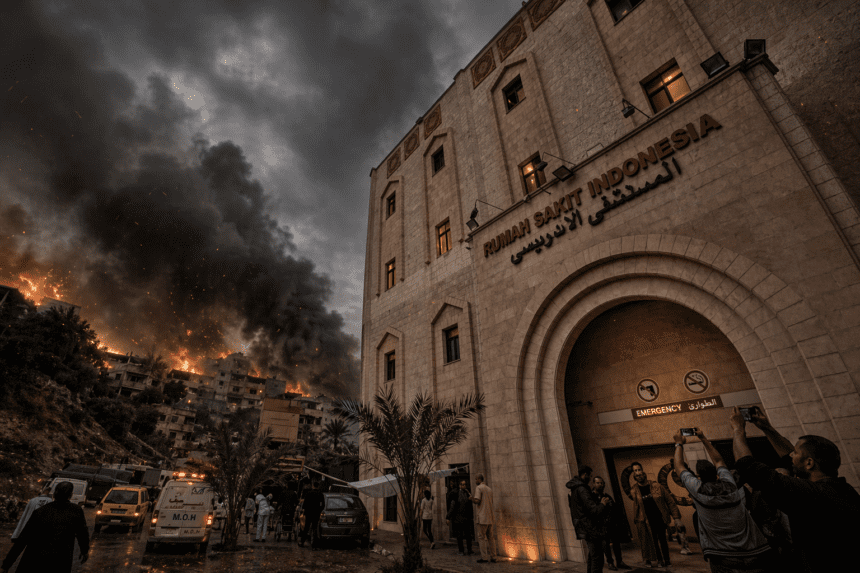
JAKARTA — Indonesia’s government has publicly condemned the display of an Israeli military banner over the ruins of a Gaza hospital, labeling the act as “propaganda” that deepens the regional crisis.
The incident centers on a viral image showing Israeli soldiers hoisting a flag and a banner atop the remains of a medical facility in the Gaza Strip. Indonesian officials argue the move violates international norms regarding the sanctity of medical infrastructure during wartime.
“It is a blatant display of insensitivity,” said a spokesperson for the Indonesian Ministry of Foreign Affairs. “Using the wreckage of a hospital—a site meant for healing—as a stage for military posturing is unacceptable.”
For Jakarta, the move is more than just a tactical provocation. It is a calculated attempt to normalize the destruction of civilian infrastructure. Indonesian diplomats have spent months pushing for a ceasefire, and they view such displays as a direct affront to the humanitarian aid efforts their country has funneled into the enclave, including the deployment of a hospital ship and field medical teams.
The Israeli military has maintained that its operations in Gaza are directed at dismantling militant infrastructure embedded within civilian zones. However, the specific placement of the banner has drawn sharp criticism from global observers who argue that the imagery serves no strategic purpose other than to humiliate the local population.
The optics of the event carry significant weight in Indonesia, a nation with the world’s largest Muslim population and a long-standing, vocal supporter of the Palestinian cause. Public sentiment in Jakarta is already volatile, and the government is walking a tightrope—balancing its diplomatic commitments with the intense anger of its domestic audience.
Analysts suggest this incident will likely complicate future back-channel negotiations. By turning a site of humanitarian tragedy into a platform for military symbolism, Israel has effectively closed the door on any perceived neutrality in the eyes of Southeast Asian mediators.
“They aren’t just fighting a war on the ground,” said one regional analyst based in Jakarta. “They are fighting a war for perception, and this stunt was a massive miscalculation that only serves to alienate potential partners.”
As the death toll in Gaza continues to climb, the banner incident serves as a stark reminder that in this conflict, the battle for the narrative is often as fierce as the fighting itself. For Indonesia, the message is clear: there is no room for propaganda on the site of a hospital.