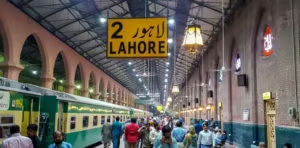
Pakistan Railways has moved to restrict unauthorised filming, photography and media coverage on its premises, signalling a tougher approach to how the country’s rail network is shown to the public at a time when the ministry is also pushing a wider modernization drive. Reports published on April 26 say the department has barred media teams, vloggers and other content creators from recording railway operations, infrastructure and certain restricted areas without prior written approval.
The restriction, as described in those reports, goes beyond casual filming. It covers operational zones and infrastructure that officials appear to view as sensitive, and it reportedly warns of legal action in cases of violation. That matters because Pakistan Railways has, over the past few years, become a surprisingly visible part of Pakistan’s online video culture, with trainspotters, travel vloggers and rail enthusiasts regularly posting footage from stations, platforms and onboard journeys.
So far, the broader official backdrop points in one direction: tighter control and more centralized management. The Ministry of Railways’ website identifies Muhammad Hanif Abbasi as the federal minister, while recent government-linked reporting says he has been overseeing an ambitious digital overhaul that includes real-time locomotive tracking, RFID-based asset monitoring, smart surveillance, upgraded control rooms and other systems meant to improve transparency, monitoring and operational efficiency.
That creates an interesting, and honestly a slightly awkward, contrast. On one hand, the ministry says it wants a more modern, transparent and internationally competitive railway system. On the other, independent visual coverage now seems set to face a higher threshold, especially where railway officials believe security, operations or sensitive infrastructure could be exposed. The government’s own messaging around reform has stressed safety, accountability and system control, which helps explain the logic behind the move even if it is likely to raise questions among journalists and digital creators.
The latest development also lands in the middle of a somewhat mixed relationship between Pakistan Railways and the media. Earlier this month, the department announced a 50 percent fare concession for the spouses of working journalists on up to 10 single journeys, though premium services were excluded. But separate reporting from early April said a longstanding journalists’ concession had been cut back, with the discount reduced from 80 percent to 50 percent and annual usage capped, prompting concern in media circles. Put simply, the policy mood has looked more restrictive than accommodating.
For now, one key unanswered question is how aggressively the new restriction will be enforced in practice. There is a big difference between blocking access to signal cabins, yards and other restricted zones, and policing routine station footage captured by passengers or hobbyist creators. Another is whether Pakistan Railways will publish a detailed public notification spelling out exactly what needs prior approval, who grants it, and what penalties apply. As of the material reviewed here, the ministry website confirms the relevant institutional leadership and hosts notifications sections, but a public notice laying out this specific policy was not clearly available in the pages I reviewed.
For editors, reporters and vloggers, that lack of visible detail is where the story really sits right now. The policy itself is attention-grabbing, sure, but the real test will be in the fine print: whether this is a narrowly drawn security measure or the start of a much broader clampdown on who gets to document one of Pakistan’s most public state-run services.