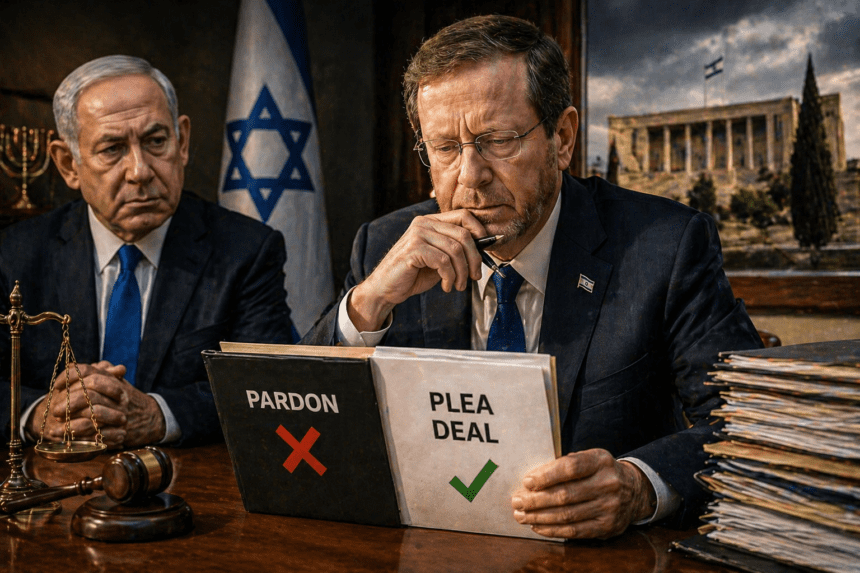
Israeli President Isaac Herzog is holding off on any decision about a possible pardon for Prime Minister Benjamin Netanyahu and is instead expected to press for a plea deal, according to recent Israeli media reports, a move that could reshape one of the country’s most divisive legal and political sagas.
The reported approach suggests Herzog is not prepared to move quickly on a direct pardon while Netanyahu’s long-running corruption trial remains unresolved. Instead, the idea under discussion is a negotiated arrangement that would end the case through legal channels rather than an immediate act of clemency from the presidency. Herzog’s office, according to reports, has indicated that any such matter would go through formal legal review and that no final decision has been taken.
That distinction matters. A pardon, especially before the full legal process has run its course, would almost certainly trigger an intense backlash in Israel, where Netanyahu’s trial has become far more than a courtroom drama. It has turned into a test of institutions, public trust, and the boundaries between political power and judicial accountability. A plea deal, by contrast, could give all sides a way out, though not a painless one.
Netanyahu has for years denied wrongdoing in the cases against him, which involve allegations of bribery, fraud, and breach of trust. The trial has dragged on long enough to become woven into the broader national argument over the judiciary, executive authority, and the conduct of public officials at the highest level. That is why even talk of a pardon lands like a political earthquake in Israel.
For Herzog, the balancing act is obvious. A straight pardon could be seen by critics as a political rescue. Pushing a plea deal instead allows the president to appear more restrained, more procedural, and less willing to short-circuit the justice system. Still, even that path would be controversial, because any settlement involving Netanyahu would immediately be judged not only on legal grounds, but on what it says about equality before the law in a country already deeply polarized.
The story is moving on two tracks at once: legal and political. Formally, it is about how a criminal case might end. In reality, it is also about legitimacy, public anger, and whether Israel’s institutions can navigate a crisis involving a sitting prime minister without deepening the divide even further. For now, Herzog appears to be buying time, not closing the door, but not opening it fully either.