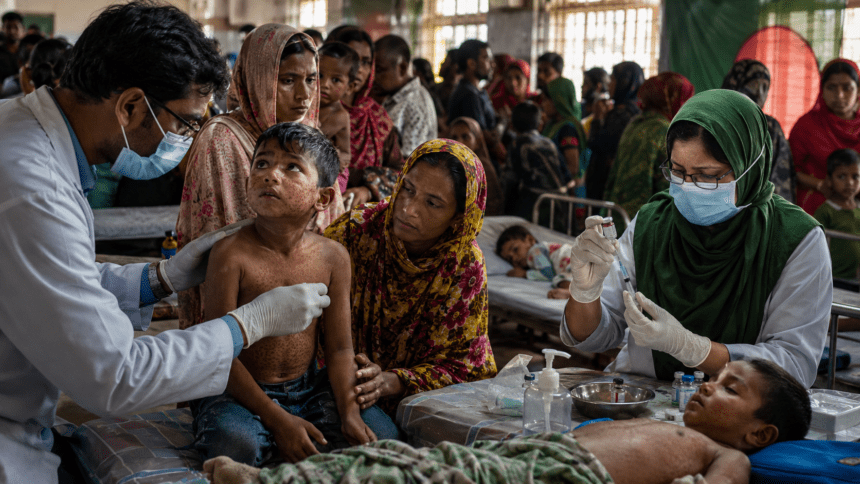
Dhaka: Bangladesh is battling one of its worst measles outbreaks in years, with thousands of children falling ill and hundreds of confirmed or suspected deaths reported since the disease began spreading rapidly in mid-March.
The outbreak has hit children under five the hardest. According to the World Health Organization, Bangladesh reported 19,161 suspected measles cases, 2,973 laboratory-confirmed cases and 166 suspected measles-related deaths between March 15 and April 14. Children under five accounted for 79% of reported cases, with many deaths occurring among unvaccinated children under two.
The situation has continued to worsen. Local health authorities reported that by mid-May, the combined number of confirmed and suspected measles deaths had climbed to 451, after 12 more children died in a single 24-hour period. Confirmed cases had risen to 7,416, while suspected cases reached 55,611, according to figures cited from the Directorate General of Health Services.
The scale of the outbreak has alarmed doctors and public health experts because measles is preventable through vaccination. But once it enters communities with low immunity, it spreads frighteningly fast. The virus is airborne and can cause fever, cough, runny nose, red eyes and a rash. In young children, especially those who are malnourished or unvaccinated, complications such as pneumonia, diarrhea, brain swelling and death can follow.
The outbreak has spread widely across Bangladesh. WHO said transmission had been reported in 58 of the country’s 64 districts by mid-April, across all eight divisions. Dhaka carried the highest cumulative burden, with clusters reported in dense informal settlements including Demra, Jatrabari, Kamrangirchar, Korail, Mirpur and Tejgaon industrial and slum areas.
Health officials say the crisis reflects dangerous immunity gaps among children who missed routine vaccines or never received them at all. A situational analysis of the outbreak found that the resurgence was linked to accumulated coverage gaps rather than vaccine failure, with a large share of cases among zero-dose and partially vaccinated children.
Bangladesh has launched an emergency measles-rubella vaccination campaign to slow the spread. WHO said the response includes a phased vaccination drive targeting children aged 6 to 59 months, along with stronger surveillance, laboratory testing and hospital preparedness.
The campaign has also reached vulnerable communities in Cox’s Bazar, including Rohingya refugee camps in Ukhiya and Teknaf. WHO said more than 166,000 children aged 6 months to under 5 years in the camps had been vaccinated as part of the national emergency response.
Still, the outbreak is a painful warning. Measles does not need much room to return. A small decline in vaccination coverage, a shortage in supplies, weak follow-up in crowded settlements or delays in reaching remote communities can leave thousands of children exposed.
For families, the advice from health workers is urgent and simple: vaccinate children, watch for fever and rash, and seek medical care early. For the government, the challenge is bigger — rebuild routine immunisation, close the gaps, and reach every child before the virus does.
Bangladesh’s measles emergency is not only a health story. It is a reminder that diseases once pushed back can come roaring back when protection slips.