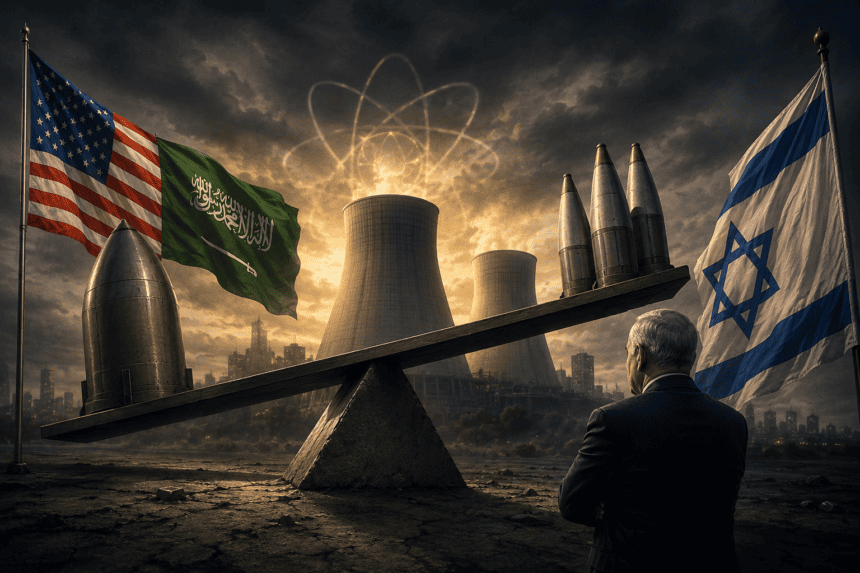
The Biden administration is moving toward a civilian nuclear agreement with Saudi Arabia, a deal that threatens to upend the delicate security architecture of the Middle East. While Riyadh insists the program is strictly for energy independence, Israeli officials are sounding alarms over the potential for a regional arms race.
The deal, part of a broader normalization package between Riyadh and Washington, would grant the Saudis access to U.S. nuclear technology and, crucially, domestic uranium enrichment capabilities. For Israeli defense planners, this is the red line. Prime Minister Benjamin Netanyahu’s cabinet fears that once the infrastructure is in place, the leap from peaceful energy generation to weapons-grade material becomes a matter of political will rather than technological hurdle.
“We aren’t just talking about reactors,” a senior Israeli security source said on condition of anonymity. “We are talking about the inevitable collapse of the regional non-proliferation standard.”
Israel has long operated under a policy of nuclear ambiguity, maintaining its own deterrent while insisting that its neighbors remain strictly non-nuclear. Washington’s willingness to bypass the “Gold Standard”—a previous requirement that prevented partners from enriching their own uranium—has left Jerusalem feeling exposed.
The White House views the pact as a strategic necessity. By bringing Riyadh into the fold, the U.S. hopes to anchor Saudi Arabia to Western technology and oversight, preventing the kingdom from turning to Beijing or Moscow for similar deals. Secretary of State Antony Blinken has argued that rigorous International Atomic Energy Agency (IAEA) monitoring will provide sufficient safeguards against diversion.
Critics in the U.S. Congress remain unconvinced. During recent closed-door briefings, lawmakers from both sides of the aisle questioned whether any oversight regime can truly guarantee that a massive enrichment facility won’t be repurposed in a future, less stable political climate.
The broader risk is the “domino effect.” If Saudi Arabia secures the right to enrich uranium, Egypt, Turkey, and the United Arab Emirates are likely to demand the same terms. A nuclear-armed neighborhood is the nightmare scenario Israel has spent decades trying to prevent.
For now, the administration is betting that the normalization of ties between Saudi Arabia and Israel will outweigh the risks of the nuclear program. Whether that gamble secures long-term peace or sets the stage for a new era of regional brinkmanship remains the central question hanging over the negotiations.
The deal is expected to move to the Senate floor by year-end, where the debate will center not just on energy, but on the future of Middle Eastern stability.