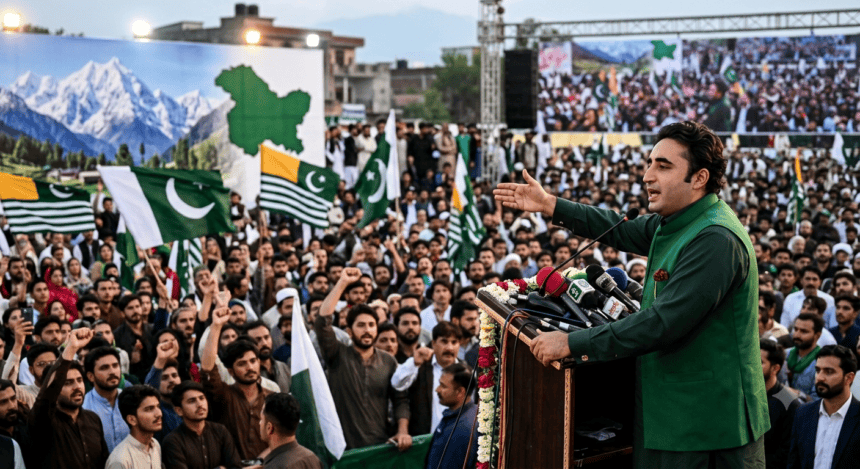
MUZAFFARABAD — Pakistan Peoples Party (PPP) Chairman Bilawal Bhutto-Zardari has issued a stern warning to the federal government, declaring that his party will not allow Azad Jammu and Kashmir (AJK) to face the same fate as Indian-Occupied Kashmir.
Speaking at a public rally in Muzaffarabad, Bilawal framed the current economic and administrative pressures on the region as a direct assault on the rights of its residents. He accused the federal establishment of attempting to strip AJK of its autonomy, suggesting that the current policies are designed to suppress political dissent rather than foster development.
“They want to treat this land like a colony,” Bilawal told the crowd. “We won’t stand by while the rights of our brothers and sisters are auctioned off for political convenience.”
The rhetoric comes amid growing unrest in the region. Recent months have seen widespread protests in AJK over electricity bills, flour prices, and the curtailment of subsidies. For many living in the territory, the economic crunch has transformed into a crisis of identity, with public anger increasingly directed at the central government in Islamabad.
Bilawal’s stance is a calculated move to capture that frustration. By positioning the PPP as the primary defender of AJK’s autonomy, he is distancing his party from the federal coalition’s unpopular fiscal measures.
However, critics point out the inconsistency in his narrative. The PPP is currently part of the federal government, and analysts argue that Bilawal’s “anti-establishment” tone is a tactical maneuver to maintain his political base in the valley without fully breaking ranks with the power structure in Islamabad.
The former foreign minister also touched upon the broader Kashmir issue, reiterating that the regional struggle remains a cornerstone of his party’s platform. He dismissed any talk of normalization with India so long as the status of the disputed territory remains unresolved.
Local observers suggest that the PPP’s aggressive stance is aimed at reclaiming lost ground in AJK, where the party has struggled to maintain its traditional dominance in recent elections. By tapping into the local fears of administrative encroachment, Bilawal is betting that the rhetoric of “protection” will resonate more deeply than promises of infrastructure development.
Whether this shift in tone leads to tangible policy changes remains to be seen. For now, the PPP chairman has set a clear red line: if the federal government continues its current course, the political friction between Muzaffarabad and Islamabad is set to intensify.