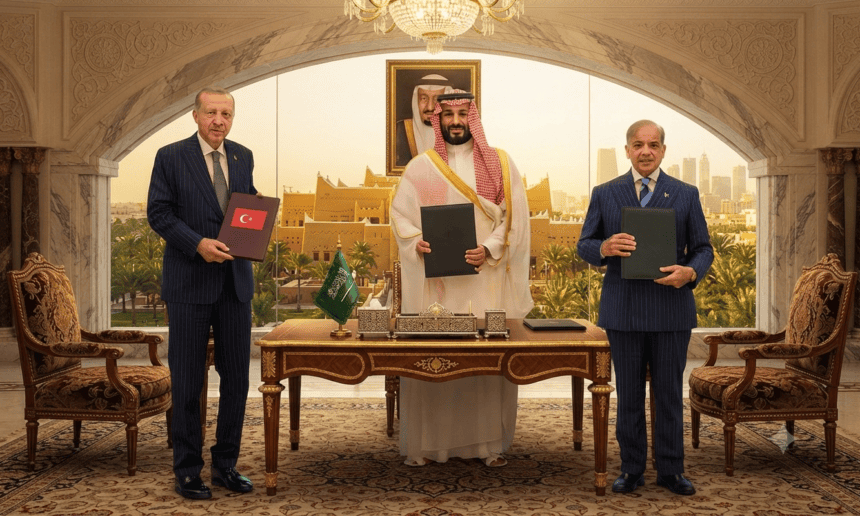
MAKKAH: Pakistan, Saudi Arabia and Turkiye have signed a joint defence agreement under which an armed attack against any one of the three countries will be considered an attack against all three, marking a major step towards closer security and defence cooperation.
The agreement was signed on Friday at Al-Safa Palace during the Makkah Al-Mukarramah Summit for Joint Defence. Prime Minister Shehbaz Sharif, Saudi Crown Prince and Prime Minister Mohammed bin Salman, and Turkish President Recep Tayyip Erdogan signed the pact.
According to a joint statement issued by the three countries, the agreement is aimed at strengthening collective security and promoting peace, stability and security in the region and beyond.
The pact provides for stronger collective deterrence against aggression and states that an armed attack on any member state will be treated as an attack against all three countries. It also calls for greater cooperation across various areas of defence.
The agreement builds on longstanding political, religious and strategic ties among Pakistan, Saudi Arabia and Turkiye, as well as years of military cooperation between the three countries.
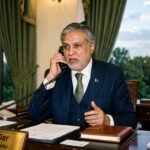
Chief of Defence Forces and Chief of Army Staff Field Marshal Asim Munir, Deputy Prime Minister and Foreign Minister Ishaq Dar and Defence Minister Khawaja Asif attended the signing ceremony. Saudi and Turkish defence and foreign ministers were also present.
The agreement carries added significance because it was signed in Makkah, Islam’s holiest city, and brings together three countries with substantial strategic and military capabilities.
Pakistan is the only nuclear-armed Muslim-majority country, Saudi Arabia is a major global energy producer and home to Islam’s two holiest sites, while Turkiye maintains one of the largest military forces within NATO.
Defence analyst Mansoor Ahmed of the Australian National University’s Strategic and Defence Studies Centre said Pakistan and Turkiye could contribute significant defence capabilities and industrial expertise, while Saudi Arabia could provide substantial financial resources for technological development.
He said, however, that the agreement was unlikely to include a nuclear component, noting that Pakistan’s nuclear deterrence remains primarily focused on the perceived threat from India.
The new agreement follows a bilateral defence pact signed by Pakistan and Saudi Arabia in Riyadh last September, under which both countries agreed that an attack on either state would be regarded as aggression against both.
Turkiye had subsequently expressed interest in becoming part of a broader defence arrangement involving Pakistan and Saudi Arabia. After months of negotiations, a draft agreement was reportedly prepared earlier this year.
The development comes amid heightened tensions in the Middle East, including the conflict involving the United States and Iran, continuing instability around Gaza and renewed tensions between Saudi Arabia and Yemen’s Houthi movement.
Saudi Arabia has also been working on plans for a multinational maritime security arrangement aimed at protecting commercial shipping and energy routes in the Red Sea. Pakistan is among the countries that have expressed support for the initiative.
During his visit to Saudi Arabia, Prime Minister Shehbaz Sharif also held a separate meeting with Crown Prince Mohammed bin Salman. President Erdogan likewise met the Saudi leader during his visit to Makkah.
Prime Minister Shehbaz arrived in Saudi Arabia on Thursday for a three-day visit, while President Erdogan travelled to Makkah on Friday for the summit.
The Pakistani delegation also included Field Marshal Asim Munir, Foreign Minister Ishaq Dar, Defence Minister Khawaja Asif, Information Minister Attaullah Tarar and Special Assistant to the Prime Minister Tariq Fatemi.
The two sides discussed ways to strengthen bilateral relations, expand strategic cooperation and exchange views on regional and international developments.
Pakistan and Saudi Arabia have maintained close defence ties for decades, with Pakistan providing military training and technical assistance to Saudi forces. Pakistan and Turkiye have also expanded defence cooperation through military exercises, training and defence equipment.
In recent years, Saudi Arabia has increased defence cooperation with Turkiye, including a major agreement to acquire Turkish-made drones, while Pakistan has also supplied military personnel and fighter aircraft to assist Saudi Arabia with its security needs.