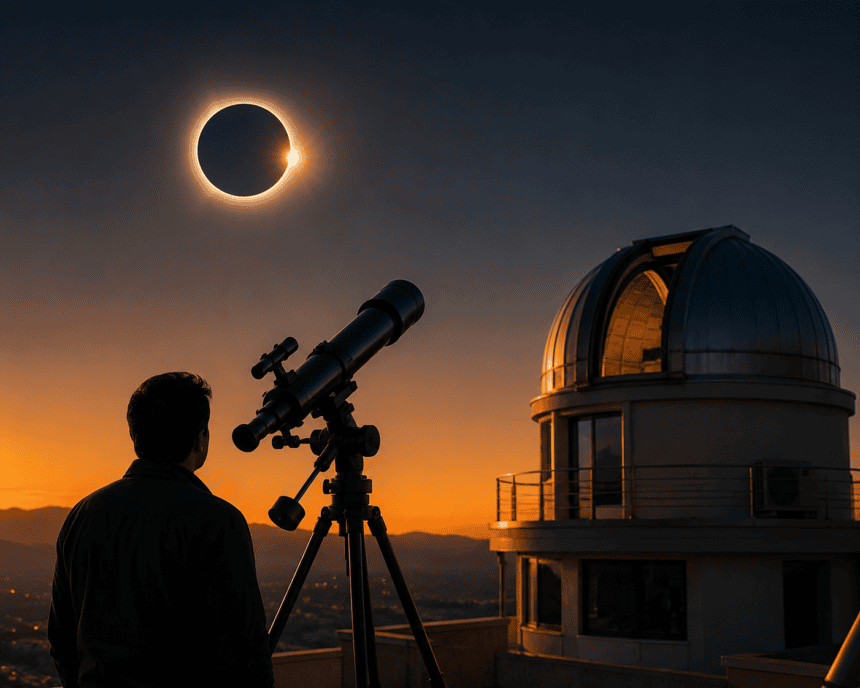
LEICESTER — While thousands of skywatchers scrambled for vantage points and expensive travel packages to catch last week’s solar eclipse, Peter Henderson simply walked into his backyard.
The 54-year-old builder spent the last three years constructing a custom observatory in his garden, complete with a retractable roof and a high-end solar telescope. When the moon slipped in front of the sun, Henderson didn’t have to fight crowds or cloud cover; he was already dialed in.
“It’s not about the gear,” Henderson said, adjusting the focus on his monitor. “It’s about being ready when the sky decides to show off.”
The images he captured are remarkably sharp, revealing intricate details of the sun’s chromosphere that are often lost in standard photography. His setup, which utilizes a specialized hydrogen-alpha filter, allowed him to document solar prominences — massive loops of plasma erupting from the sun’s surface — during the peak of the eclipse.
For Henderson, the observatory is a labor of love. He built the structure using leftover timber from his construction projects and sourced the telescope components piece by piece on the secondary market. The total cost was a fraction of what professional labs spend, yet the clarity of his footage has caught the attention of local astronomy societies.
The project began as a way to cope with long hours on job sites. He started by sketching star charts on the back of blueprints. That hobby turned into a permanent fixture of his home, transforming a patch of grass into a gateway to the solar system.
Professional astronomers note that backyard setups like Henderson’s are becoming vital. As light pollution increases in urban areas, these private, specialized stations provide consistent data that larger, public observatories sometimes miss.
Henderson isn’t looking for fame or academic recognition. He’s already planning his next project: a camera rig capable of tracking deep-space nebulae.
“The eclipse was just the test run,” he said. “The real work happens when the sky goes dark.”