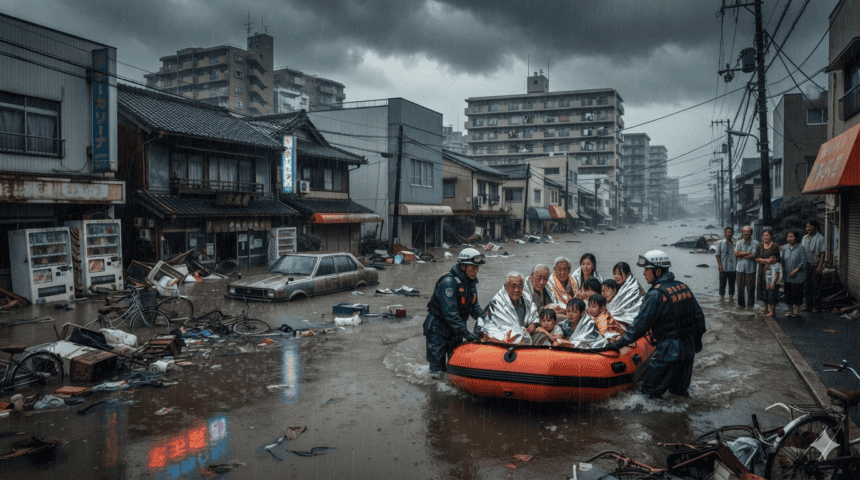
Torrential rains triggered catastrophic flooding and landslides across Japan’s Noto Peninsula today, claiming at least eight lives and leaving thousands cut off from emergency services. The downpour—the heaviest recorded in the region since current tracking began—has transformed local streets into rivers and overwhelmed aging infrastructure already struggling to recover from January’s earthquake.
Wajima and Suzu, cities still bearing the scars of New Year’s seismic activity, bore the brunt of the deluge. Emergency crews recovered six bodies near a tunnel construction site in Wajima, while two additional fatalities were confirmed in the surrounding areas. As of this evening, officials have lost contact with several residents in remote mountain villages, and authorities are scrambling to reach those trapped by mudslides that severed primary access roads.
For the survivors, the timing is cruel. Many were living in temporary housing units after losing their homes to the magnitude 7.6 earthquake earlier this year. Today’s rainfall turned those makeshift shelters into islands, with floodwaters reaching rooflines in low-lying districts.
“We haven’t even finished clearing the rubble from the last disaster,” one resident told local broadcasters while waiting for a rescue boat. “Now the water is taking what little we had left.”
The Japan Meteorological Agency issued its highest-level “emergency warning” for the Ishikawa Prefecture, citing rainfall rates exceeding 120 millimeters per hour. While the intensity began to taper off by late afternoon, the ground remains dangerously saturated. The risk of secondary landslides persists, complicating efforts for Self-Defense Forces personnel currently working to clear debris and restore power to roughly 6,000 households still in the dark.
While the government has mobilized thousands of rescue workers, the geography of the Noto Peninsula makes rapid deployment difficult. Narrow, winding roads—already damaged by the January tremor—have been blocked by earth and downed power lines. Prime Minister Fumio Kishida ordered an all-out effort to rescue the missing, though he faces mounting criticism over the speed of recovery efforts in the region throughout the year.
The rain may have stopped, but the crisis is far from over. With weather patterns becoming increasingly volatile, the residents of Ishikawa are left to wonder if their region can ever truly return to stability. For now, the focus remains on the missing—and the freezing temperatures expected as night falls over the flooded peninsula.