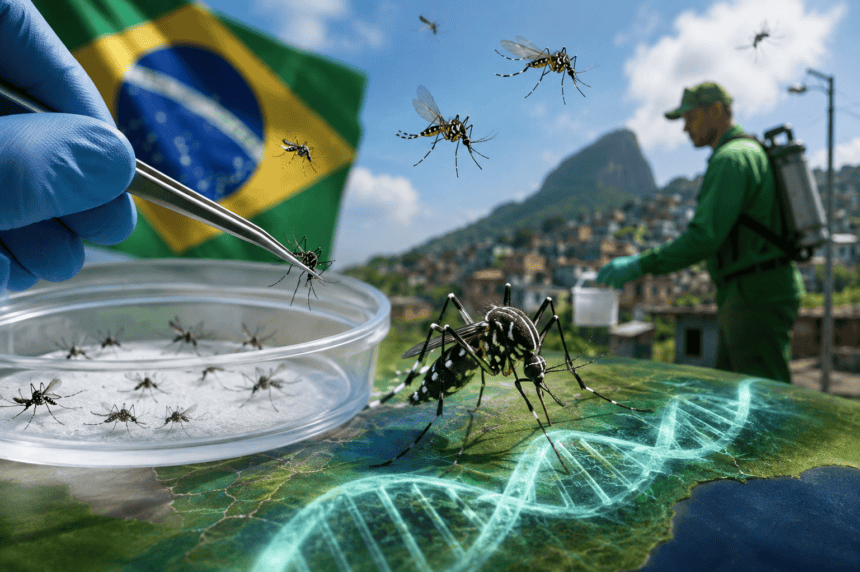
FIOCRUZ, BRAZIL — In a quiet lab on the outskirts of Rio de Janeiro, scientists are breeding millions of mosquitoes designed to kill their own kind. It isn’t science fiction. It’s the latest, most aggressive attempt by Brazil’s health authorities to curb a record-breaking surge in dengue fever.
The strategy relies on a specialized bacterium called *Wolbachia*. When introduced into *Aedes aegypti* mosquitoes, the bacteria act as a biological blockade, preventing the insects from transmitting viruses like dengue, Zika, and chikungunya to humans.
The results are shifting the landscape of public health in the country. Data from the Oswaldo Cruz Foundation (Fiocruz) shows that in neighborhoods where these modified mosquitoes were released, dengue cases plummeted by up to 70% compared to untreated areas.
Health officials are now scaling up production. A new, massive “mosquito factory” in Curitiba is capable of churning out billions of these insects annually. The plan is to distribute them across major urban centers where dengue outbreaks have historically overwhelmed hospitals and clinics.
Critics have raised questions about the long-term ecological impact of releasing billions of lab-grown insects into the wild. Despite these concerns, the Brazilian Ministry of Health maintains that the biological intervention is the only viable path forward. Traditional methods—such as chemical fogging and community-led trash removal—have failed to keep pace with the mosquito’s rapid adaptation to urban environments.
The human cost of the failure to contain the spread is staggering. Brazil recorded over 1.6 million dengue cases in the first few months of 2024 alone, a figure that eclipsed previous annual records. For the families in the hardest-hit states, the biological solution isn’t just an experiment; it’s a necessary defense against a recurring seasonal nightmare.
As the release program expands, the focus shifts to the streets. The true test will come next summer, when the heat and humidity return, and the lab-grown mosquitoes face their first real-world challenge in the dense, sprawling favelas of Rio and São Paulo. If the suppression rates hold, Brazil will have successfully pioneered a blueprint for global infectious disease control.
If not, the country remains at the mercy of a tiny, persistent vector that has already proven it can outmaneuver almost every weapon thrown its way.