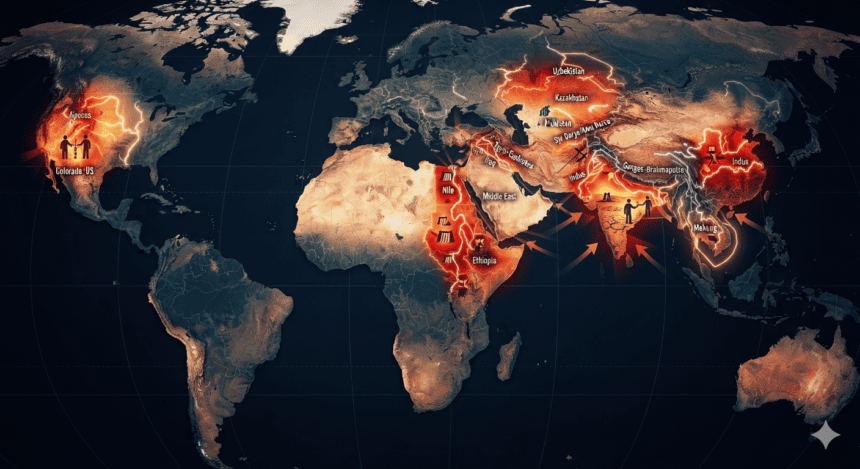
The map of global instability in 2026 is being drawn not by borders, but by river basins. As climate-induced droughts stretch thin the resources of already fragile states, the competition for water is moving from a diplomatic headache to an acute security threat.
Central Asia and the Horn of Africa are the front lines. In the Fergana Valley, where the borders of Kyrgyzstan, Tajikistan, and Uzbekistan intersect, local skirmishes over irrigation canals have become a grim seasonal ritual. By 2026, the convergence of record-low snowpack in the Pamir Mountains and aging, leaky Soviet-era infrastructure has left regional governments with little room to maneuver. When the taps run dry in these border villages, the violence that follows is rarely just about water—it’s about survival.
Down in the Horn of Africa, the Nile basin remains a powder keg. Ethiopia’s continued filling of the Grand Ethiopian Renaissance Dam (GERD) has effectively placed Egypt’s agricultural lifeline under external control. While high-level summits continue in Addis Ababa and Cairo, the reality on the ground is different. Egyptian farmers are already pivoting away from water-intensive crops, and the psychological weight of potential scarcity is fueling a domestic nationalist fervor that makes compromise increasingly difficult for leadership in Cairo.
Experts point to the “hydro-hegemony” dynamic as the core of the problem. Upstream nations are prioritizing energy and development, while downstream nations view the same water as an existential right. In 2026, this isn’t just a political disagreement; it’s a race against the weather.
The Mekong River basin in Southeast Asia tells a similar story. China’s upstream dam operations, coupled with record-low rainfall in Thailand and Vietnam, have decimated the fish stocks that millions rely on for protein. Local fishing communities aren’t waiting for international arbitration. They are moving, shifting demographics, and creating new points of friction in regions already strained by economic volatility.
Water security is no longer an environmental side note. It is the primary variable in the stability of these regions. When the resource becomes scarce, the state’s ability to provide—or keep the peace—evaporates with it.
“We aren’t looking at a future of water wars; we are living through the slow-motion collapse of resource management,” says senior water security analyst Marcus Thorne. “By the time the international community labels it a crisis, the people living on those riverbanks have already lost their livelihoods.”
As 2026 progresses, the flashpoints won’t be defined by formal declarations of war. They will be defined by the quiet closing of a sluice gate or the sudden drying of a communal well—the kind of triggers that turn a bad harvest into a regional emergency.