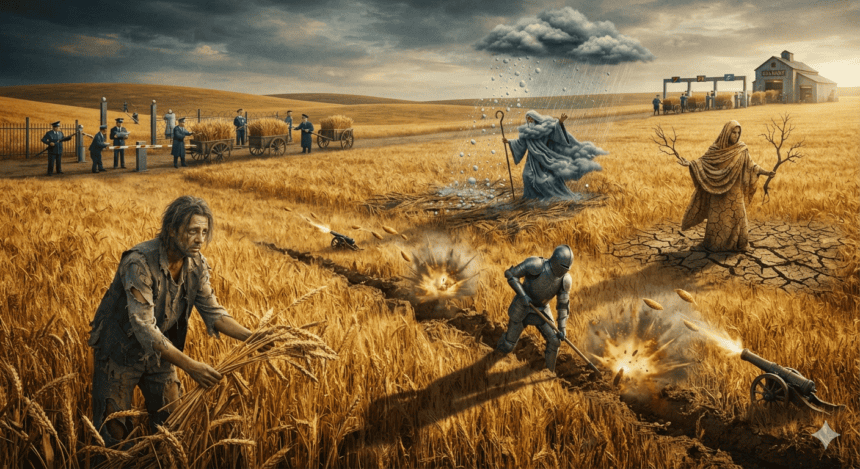
The world’s primary breadbaskets are failing. From the fertile plains of Ukraine to the drought-stricken fields of the American Midwest and the protectionist corridors of global trade, the systems that feed the planet are buckling under a sustained, three-pronged assault.
Global wheat and corn supplies are tightening, not because of a single disaster, but because the mechanisms of global food production are being dismantled in real-time.
In Ukraine, the ongoing war has turned fields into minefields. Farmers aren’t just battling weather; they are dodging artillery. Millions of hectares remain unplanted or inaccessible, stripping a major global exporter of its capacity to stabilize prices. When a breadbasket becomes a battlefield, the shockwaves reach every supermarket shelf from Cairo to Caracas.
Climate volatility is hitting the other side of the ledger. In the United States and Brazil—two of the world’s most critical agricultural producers—extreme weather has become the new baseline. Prolonged heatwaves and erratic rainfall patterns are slashing crop yields, leaving little room for error. When the rain doesn’t fall, or when it falls all at once, the global inventory buffer vanishes.
Trade politics are making the situation worse. Rather than cooperating to secure supply chains, nations are turning inward. Export bans on rice, wheat, and fertilizer have become a common reflex for governments desperate to keep domestic prices low. These “beggar-thy-neighbor” policies create artificial scarcity, pushing prices higher for everyone else and triggering a cycle of panic buying.
The price of staples is no longer just a metric of supply and demand. It is a barometer of geopolitical friction.
“We are seeing a fragmentation of the global food market,” says Sarah Mendelson, an agricultural commodities analyst. “Countries are prioritizing self-sufficiency over efficiency, and in doing so, they are breaking the very trade routes that kept food affordable for the last thirty years.”
Data from the International Grains Council reflects the strain. Global grain stocks-to-use ratios—a key indicator of food security—have hit their lowest levels in a decade. The margin for error is effectively gone. A single bad harvest or a new escalation in a conflict zone could turn localized food inflation into a full-blown global crisis.
The era of cheap, reliable food abundance is ending. As climate change reshapes growing seasons and geopolitical lines harden, the world is moving toward a future where the next meal isn’t guaranteed by market forces, but by the precarious stability of a fractured global order.