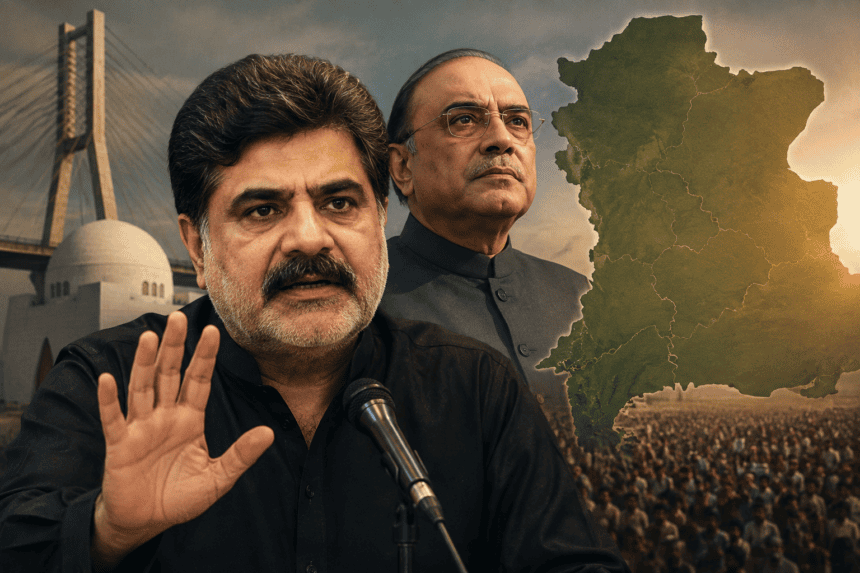
Sindh Minister for Local Government Nasir Hussain Shah has dismissed rumors of the province’s bifurcation, stating that as long as Asif Ali Zardari holds the office of President, the territorial integrity of Sindh remains untouchable.
Speaking to reporters in Karachi, Shah addressed growing political anxiety regarding potential administrative changes. He framed the President’s presence in Islamabad as a direct safeguard against any move to divide the province—a sensitive topic that has historically triggered fierce political and ethnic friction in the region.
“As long as Asif Ali Zardari is in the presidency, no power can divide Sindh,” Shah said. He dismissed the ongoing speculation as “political kite-flying” intended to unsettle the provincial administration rather than reflect any genuine policy shift within the federal government.
The minister’s comments arrive at a time when the Pakistan Peoples Party (PPP) faces intense scrutiny over its governance in Sindh. Critics, particularly from the opposition, have frequently alleged that the party’s focus remains narrow, often ignoring the urban-rural divide that has defined the province’s politics for decades. By invoking the President’s name, Shah is signaling that the party’s leadership is prepared to use its federal influence to shut down any discourse on partitioning the province.
The issue of Sindh’s division has long been a political lightning rod. Proposals ranging from the creation of new administrative units to the separation of Karachi have been floated by various factions over the years, usually during periods of heightened instability. Each time, such suggestions have been met with swift, often aggressive pushback from nationalist groups and the PPP, who view the geography of Sindh as inseparable from its cultural identity.
Shah’s hardline stance serves a dual purpose. It reaffirms the party’s commitment to the status quo while simultaneously attempting to consolidate its voter base by positioning the PPP as the sole defender of the province’s borders.
Despite the minister’s categorical rejection, the rumors underscore a persistent lack of trust between the provincial government and its detractors. For now, the PPP is betting that the presence of its co-chairman at the helm of the country’s highest office will be enough to quell the talk—at least for the remainder of his term.