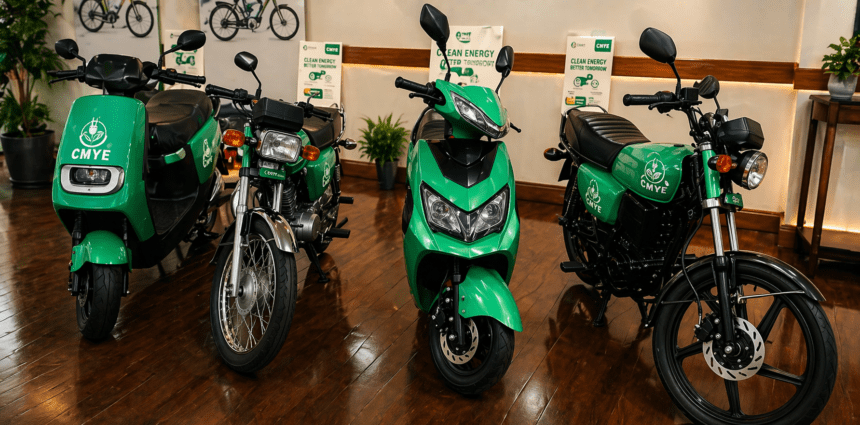
Prime Minister Shehbaz Sharif has announced that government employees up to Grade 16 will be offered electric bikes on easy instalments, in what looks like the clearest sign yet that Islamabad wants to turn its electric-vehicle push into something ordinary commuters can actually use. The announcement came during a meeting in Islamabad on April 22, where the prime minister reviewed steps to speed up EV adoption across the country.
According to reporting that cited a statement from the Prime Minister’s Office, Shehbaz said the shift toward electric vehicles was no longer just about cleaner transport. In his telling, it has become tied to a bigger national calculation: cutting the fuel import bill, easing pressure created by volatile international oil prices, and improving energy security at a time when Pakistan remains heavily exposed to imported fuel.
That framing matters. For months, the government has been presenting EV adoption not simply as an environmental project, but as an economic one. Earlier official messaging around the national EV push stressed that subsidies and support for electric bikes were meant to lower running costs for citizens, reduce pollution, and build local industry at the same time. A separate government press release in June 2025 described a campaign tied to subsidies for 116,000 electric bikes, with a quarter of the allocation reserved for women.
The latest move appears to carve out a practical lane within that broader plan: salaried lower- and middle-tier public employees, many of whom commute daily on motorcycles and feel fuel price shocks almost immediately. It’s a politically smart audience, too. Easy-installment bikes are easier to sell than abstract policy targets, and they give the government something tangible to point to as it tries to show that the EV transition can reach beyond wealthier urban buyers. This is an inference based on the structure of the scheme and the employee eligibility bracket announced so far.
The prime minister also directed officials to speed up implementation of subsidies for electric motorcycles aimed at low-income individuals and to make sure the process stays transparent. That emphasis on transparency has been a recurring theme in the government’s EV messaging. Under the National Electric Vehicle policy framework, officials have already said applications, verification and subsidy disbursement would run through a digital platform, with third-party checks built into the process.
Officials at the April 22 meeting said Pakistan has already issued 72 manufacturing certificates for electric motorcycles and rickshaws, along with four for electric cars, suggesting the government wants to show the supply side is beginning to move as well. That matters because Pakistan’s EV ambitions have often run into a basic problem: policy announcements arrive faster than charging networks, after-sales service and local manufacturing capacity. This time, the government is trying to argue that the ecosystem is starting to catch up.
There are still important questions the government has not publicly answered in detail. Officials have yet to spell out the monthly instalment range for employees, which banks or financing partners will be involved, how applications will be processed, or whether the employee scheme will sit inside the existing subsidy pool or run alongside it. Those details will decide whether the plan becomes a real commuter relief measure or just another headline that struggles in rollout. The current reporting confirms the announcement, but not the operational fine print.
Still, the direction is pretty clear now. Islamabad is trying to make electric bikes part welfare support, part industrial policy and part import-saving strategy. For government employees who spend a painful chunk of their salaries on petrol, the promise of an e-bike on manageable instalments may sound less like climate policy and more like overdue relief. Whether that promise holds up will depend on the terms the government publishes next.