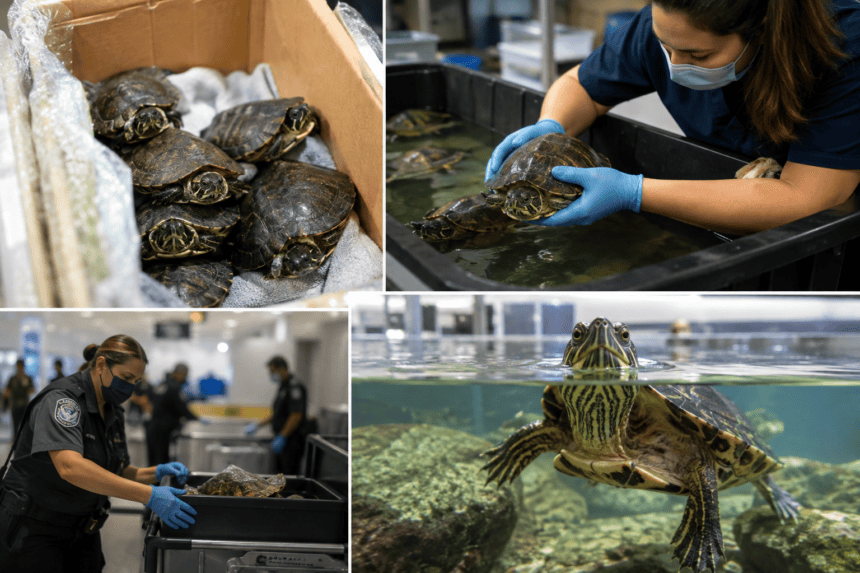
NEW YORK: Dozens of turtles rescued from an illegal wildlife-smuggling operation at John F. Kennedy International Airport (JFK) are recovering at the Bronx Zoo, where specialists are providing medical care and rehabilitation to the animals before they can potentially be returned to the wild.
The turtles, including eastern box turtles and ornate box turtles, were intercepted by US wildlife officials after smugglers attempted to ship them out of the United States. Authorities say turtle trafficking has increased significantly in recent years, driven in part by growing demand for exotic pets in China and other Asian markets.
Turtles Rescued From Smuggling Attempts
The rescued animals are now being kept in specially prepared enclosures at the Bronx Zoo. They are being given space to burrow, access to heat lamps and veterinary care while specialists monitor their health.
US Fish and Wildlife Service officials say more than 2,500 turtles have been intercepted at US airports, international mail facilities and express shipment hubs so far this year, highlighting the scale of the illegal trade.
Growing Demand for Exotic Pets
Conservation experts say the illegal trade has expanded alongside a growing market for exotic pets in China.
Turtles are particularly attractive to some urban buyers because they require relatively little living space compared with many other exotic animals. However, conservationists warn that the demand is putting additional pressure on wild turtle populations in the United States.
Several box turtle species are protected under international wildlife trade regulations and require permits to be legally transported across borders.
Cruel Conditions During Smuggling
Wildlife officials say the turtles are often subjected to extremely poor conditions during transportation.
Traffickers have reportedly packed turtles inside socks and diapers, used duct tape to restrict their shells and deprived them of food and water. Many animals do not survive the journey.
Officials say smugglers often treat the animals as disposable commodities, replacing those that die with more turtles taken from the wild.
Bronx Zoo Faces Growing Pressure
The Bronx Zoo has become an important rehabilitation centre for confiscated turtles because relatively few facilities in the United States can accommodate large numbers of rescued reptiles.
More than 850 rescued turtles have arrived at the zoo since October 2024, putting additional pressure on staff and resources. Zoo officials say receiving hundreds of turtles at once represents a major challenge for an institution already caring for thousands of animals.
Veterinarians have also identified more than a dozen previously unidentified virus variants in turtles brought into their care, creating another challenge for rehabilitation and eventual release.
Why the Turtles Cannot Be Released Immediately
Although returning the rescued turtles to the wild remains the ultimate goal, authorities cannot simply release them after confiscation.
Some animals may have injuries or illnesses, while others may have been captured far away from the location where they were seized. There is also a risk that turtles kept in crowded conditions could acquire pathogens and transmit them to wild populations.
About half of the turtles that have arrived at the Bronx Zoo this year have been transferred to state agencies, with the hope that they can eventually be returned to suitable natural habitats.
Authorities Continue Crackdown on Trafficking
US wildlife authorities are continuing investigations into networks involved in turtle poaching and smuggling.
In a recent case, at least 162 eastern box turtles and three-toed box turtles were found abandoned in New Jersey as investigators closed in on a suspected smuggler. Officials say the incident was connected to an ongoing investigation.
Authorities are urging the public to report suspicious activity involving people collecting large numbers of wild turtles.
The rescued animals at the Bronx Zoo now face a long road to recovery, but for many of them, the intervention has provided a second chance after being removed from an illegal wildlife trade.