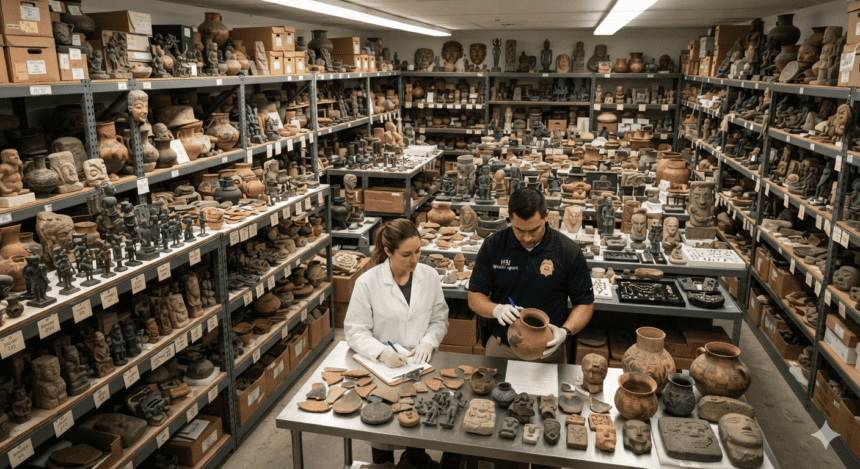
Federal agents have recovered more than 22,000 ancient artifacts from a private residence in Florida, marking one of the largest seizures of stolen cultural property in U.S. history. The collection, which spans thousands of years and multiple continents, was amassed by a private collector whose identity remains under seal as the investigation continues.
The sheer volume of the cache caught investigators off guard. Agents from Homeland Security Investigations (HSI) spent weeks cataloging the haul, which includes pre-Columbian pottery, Roman-era coins, and rare fossils from the Middle East. Some of the items are confirmed to be looted from protected archaeological sites.
“This isn’t just a collection; it’s a crime scene,” said one official involved in the operation. “Every piece here represents a piece of history ripped away from its rightful home.”
The investigation began following a tip from international heritage watchdogs who flagged the suspect for purchasing items through black-market channels. Traffickers often move these goods through shell companies and falsified shipping documents, making it difficult for customs officials to flag them as they cross borders.
For years, the black market for antiquities has operated in the shadows of high-end auction houses and online private forums. While the U.S. government has ramped up efforts to repatriate stolen items to countries like Iraq, Egypt, and Italy, the scale of this Florida seizure highlights the persistent demand for illicit cultural heritage.
Archaeologists point out that the damage goes beyond the theft itself. When artifacts are dug up by looters, the context—the soil layers, the positioning of other objects—is destroyed. This data is often more valuable to historians than the object itself.
The items are currently being held at a secure federal facility while experts work to verify their origins. Once the provenance is established, the long process of repatriation will begin. For now, the focus remains on the suspect, who faces a series of federal charges related to the illegal importation and possession of stolen property.
The case serves as a sharp reminder that the trade in human history remains a multi-billion dollar industry — one that is increasingly finding its way into quiet residential neighborhoods.