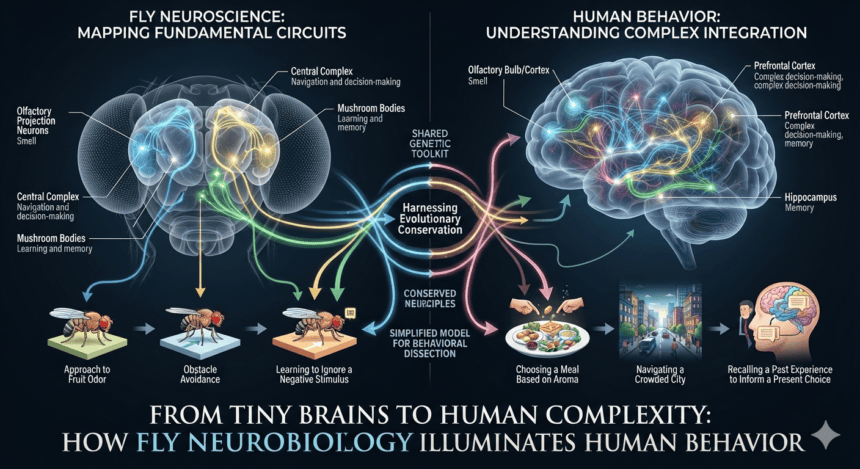
Neuroscientists have finally mapped the entire brain of a fruit fly, a breakthrough that offers a high-resolution blueprint for understanding how neural circuits dictate behavior. While the *Drosophila melanogaster* is a mere insect, its brain shares surprising architectural similarities with the human mind, providing a roadmap for how we make decisions, navigate environments, and process complex information.
For decades, the sheer complexity of the brain—with its millions of neurons and trillions of synaptic connections—remained a black box. This new map, the first complete “connectome” of an adult fruit fly, details nearly 140,000 neurons and 50 million connections. It isn’t just a static image; it’s a functional circuit diagram that shows exactly how signals travel from sensory input to physical action.
Why does this matter to us? Human brains are vastly more complex, yet the underlying logic of neural connectivity is conserved through evolution. By identifying the specific pathways that allow a fly to choose between feeding or fleeing, researchers can isolate the fundamental “wiring” responsible for decision-making.
“We are looking at the basic building blocks of cognition,” said one lead researcher involved in the mapping project. “If we can understand how a fly’s brain resolves conflict between competing drives, we gain a direct window into the biological constraints of our own behavior.”
The implications for human health are immediate. Many neurological and psychiatric conditions—including autism, schizophrenia, and depression—are increasingly viewed as “circuitopathies,” or issues of miswired neural networks. With this fly brain map, scientists can now simulate how specific genetic mutations degrade these pathways. It’s a level of precision that was impossible when researchers were essentially guessing at the circuitry.
The mapping process itself was a feat of industrial-scale biology. Scientists sliced the fly brain into thousands of ultra-thin sections, imaged them with high-powered electron microscopes, and used AI to stitch the images together. It took years of labor, but the result is a digital database that allows any lab in the world to trace a single neuron from start to finish.
Critics of the study argue that a fly’s behavior is too rigid to provide meaningful insight into human consciousness. They point to our capacity for abstract thought and complex language—traits that clearly don’t exist in the insect world.
Yet, the proponents of this research aren’t claiming that a fly is a miniature human. They are arguing that you cannot understand the skyscraper without first understanding the steel beams. We now have the blueprints for those beams. As we map more complex organisms, the gap between a fly’s instinctual navigation and human decision-making may prove to be a matter of scale, not a difference in fundamental design.