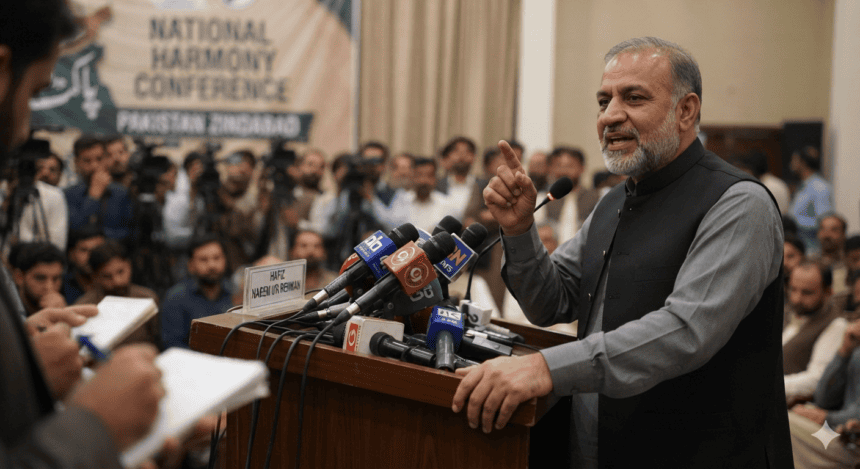
Jamaat-e-Islami (JI) Emir Hafiz Naeemur Rehman has issued a sharp rebuke to separatist elements in Sindh, stating that slogans advocating for “Sindhu Desh” hold no weight in the national discourse. Addressing a public gathering, he emphasized that the unity of the country remains non-negotiable.
“No slogan of Sindhu Desh will work here,” Rehman told the crowd. “There is only one Pakistan, and its integrity is the collective responsibility of every citizen, regardless of their province.”
The JI chief’s comments come amid simmering political tensions in the province, where various nationalist factions have recently intensified their rhetoric regarding provincial autonomy and resource distribution. By taking a hardline stance, Rehman is positioning his party as a primary defender of national cohesion, aiming to neutralize the influence of separatist narratives that have occasionally gained traction in parts of rural Sindh.
Critics of the nationalist movement argue that these separatist calls are often used as political leverage to secure concessions from the federal government. Rehman’s rejection of this approach signals a shift toward a more aggressive, state-centric narrative for the Jamaat-e-Islami as it attempts to regain political ground in Karachi and interior Sindh.
During his address, Rehman also pivoted to the economic grievances fueling regional dissatisfaction. He argued that while Sindh has genuine complaints regarding the distribution of resources and the management of local industries, the solution lies in administrative reform and electoral accountability, not in questioning the state’s borders.
“You cannot blame the map for the failures of the ruling elite,” he said.
The statement serves as a clear warning to nationalist leaders that the Jamaat-e-Islami will actively counter any movement that challenges the constitutional status of the country. As the political landscape in Sindh remains fractured between the ruling Pakistan Peoples Party (PPP), the MQM-P, and various nationalist groups, Rehman’s intervention adds a new layer of friction to an already volatile electoral environment.
Whether this rhetoric resonates with a public increasingly frustrated by inflation and poor governance—rather than constitutional debates—remains the central question for his party’s future in the region.