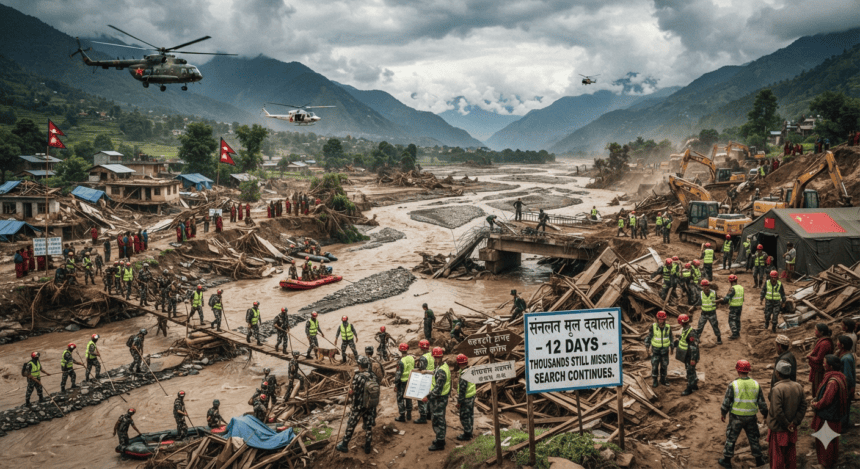
Twelve days after catastrophic floods ripped through the border regions of China and Nepal, the search for thousands of missing residents has shifted from a rescue operation to a desperate recovery effort. Mudslides and overflowing riverbanks have turned mountain villages into debris fields, leaving rescue crews battling treacherous terrain and dwindling hope.
The sheer scale of the destruction has overwhelmed local infrastructure. Entire sections of mountain roads have vanished, isolating remote communities that were already difficult to reach before the monsoon surge. Heavy machinery sits idle on the outskirts of the worst-hit zones, unable to navigate the thick, unstable sludge that covers what used to be homes and marketplaces.
Government officials in both countries face mounting pressure from grieving families. In Nepal, survivors are staging impromptu protests, demanding more helicopters and specialized search teams. They argue that the initial response was hindered by bureaucratic delays and a lack of coordination between regional authorities.
“We haven’t seen a single excavator in our village since the rain stopped,” said one resident, who lost his entire family to a landslide last week. “We are digging with our hands, but the earth is too heavy.”
Data from regional disaster management centers paints a grim picture. With thousands still unaccounted for, the death toll is expected to climb significantly as receding waters reveal more casualties. The floods have also destroyed critical power lines and communication towers, creating an information vacuum that complicates rescue logistics.
China’s emergency response units have moved across the border to assist, but even their advanced equipment faces the reality of the geography. The Himalayas offer no shortcuts. Every kilometer gained toward the disaster zone requires clearing massive boulders and fallen timber, a task that consumes hours rather than minutes.
Meteorologists warn that while the rains have eased, the ground remains dangerously saturated. Any additional precipitation could trigger secondary landslides, potentially endangering the very crews currently searching for survivors.
For the families waiting at collection centers, the reality is setting in. The window for finding survivors in the debris is closing, and the focus is now turning toward the grim task of identifying the dead—a process that may take months in the hardest-hit, inaccessible valleys.