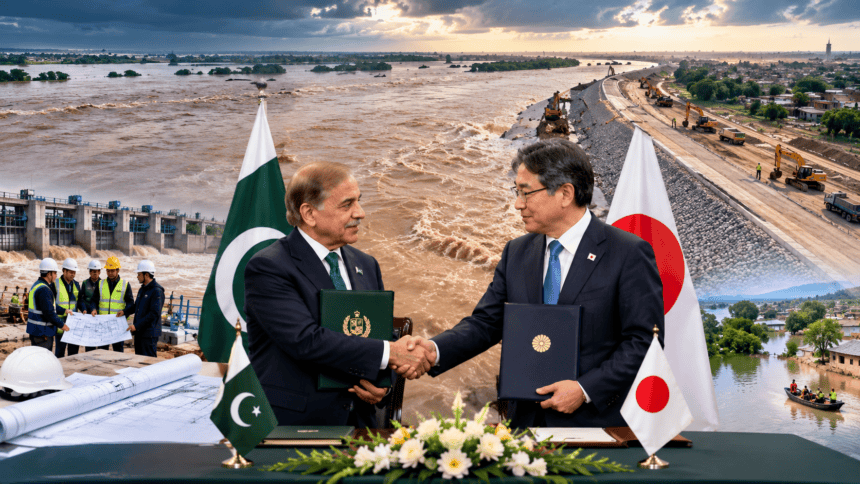
ISLAMABAD — Pakistan and Japan signed a grant agreement worth $16.4 million on Tuesday to fund a critical flood protection project, a move intended to fortify the country’s infrastructure against increasingly volatile climate patterns.
The agreement, formalized in Islamabad, targets the rehabilitation of flood-damaged facilities and the installation of early warning systems. Both nations view the project as a necessary step to mitigate the catastrophic impact seen during the 2022 super-floods, which submerged a third of the country and caused over $30 billion in damages.
Economic Affairs Minister Ahad Cheema and Japanese Ambassador Wada Mitsuhiro led the signing ceremony. For the Japanese government, the funding is part of a broader commitment to climate resilience in the Global South. For Islamabad, it represents a rare influx of non-debt financing at a time when the national budget remains heavily constrained by debt servicing requirements.
The project focuses on high-risk zones where previous infrastructure failed to contain monsoon surges. Engineers plan to upgrade existing embankments and integrate satellite-linked sensors that provide real-time data to provincial disaster management authorities.
“This isn’t just about rebuilding walls,” said a senior official familiar with the project’s technical scope. “It’s about moving from emergency response to predictive management.”
Despite the infusion of funds, the scale of Pakistan’s climate vulnerability remains vast. While $16.4 million provides essential technical upgrades, it covers only a fraction of the total infrastructure overhaul required to secure the Indus River basin. The government has struggled to secure long-term climate financing, often finding itself locked in negotiations with multilateral lenders that prioritize fiscal consolidation over environmental spending.
The partnership underscores Tokyo’s long-standing role as one of Pakistan’s primary bilateral donors. Since the 1950s, Japan has consistently bypassed shifting political tides in Islamabad to focus on infrastructure and energy projects, maintaining a pragmatic diplomatic lane that few other G7 nations have mirrored.
Construction is slated to begin in the coming fiscal quarter, with the Japanese International Cooperation Agency (JICA) overseeing the procurement process to ensure the funds are shielded from bureaucratic delays.
The real test, however, will be the upcoming monsoon season. If the new early warning systems perform as promised, the government may finally have a blueprint to scale similar projects across the country’s most flood-prone districts.