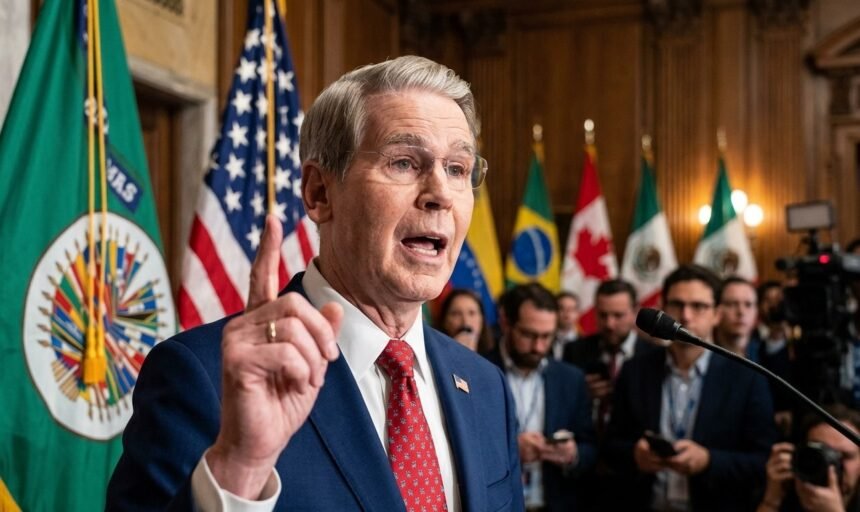
WASHINGTON: US Treasury Secretary Scott Bessent has claimed that Washington’s international campaign to economically isolate Iran is beginning to produce results, as the United States intensifies pressure on Tehran through restrictions targeting Iranian airlines, banks and financial networks.
Bessent said on Saturday that he had directed Treasury teams to engage with governments around the world and press them to take action against Iran. According to the Treasury secretary, the administration’s efforts are aimed at limiting Iran’s access to international financial and commercial systems.
Bessent highlighted recent measures taken by several countries as evidence of the campaign’s progress. Turkey and Oman have halted incoming flights by Iranian private carrier Mahan Air, while the United Arab Emirates has stopped flights operated by Iranian airlines. The UAE is an important regional aviation and commercial hub for Iranian carriers and businesses.
The US Treasury chief also pointed to new restrictions involving Iranian banks. On Wednesday, the UAE central bank blocked transactions to and from branches of Iran’s Bank Melli, citing alleged violations of laws relating to money laundering, terrorism and arms proliferation. Turkey also recently revoked the operating licence of Iran’s Bank Mellat, which has previously faced Western sanctions.
According to a Wall Street Journal report cited by Bessent, US Treasury officials have held discussions with more than 50 countries as Washington seeks broader international cooperation against Tehran. Jonathan Burke, the Treasury’s assistant secretary for terrorist financing, reportedly travelled across the Middle East and Europe to encourage governments and financial institutions to support the US pressure campaign.
Bessent had earlier warned that Washington intended to shut down Iranian commercial airline operations internationally and cautioned foreign companies and airports against providing services to Iranian carriers. The US has also warned financial intermediaries that facilitate transactions connected to Tehran that they could face restrictions on their access to the US financial system.
However, the campaign has not completely halted Iran’s international aviation links. Smaller Iranian airlines continue to operate some international routes, particularly to China, despite pressure from Washington. This indicates that the effectiveness and reach of the US campaign remain dependent on how individual countries and businesses respond to the American measures.
The latest developments come amid continuing tensions between Washington and Tehran, with the Strait of Hormuz remaining at the centre of the wider confrontation. Iran has continued to call for a diplomatic solution, while recent proposals concerning the reopening of the strategic waterway and resumption of negotiations remain disputed.