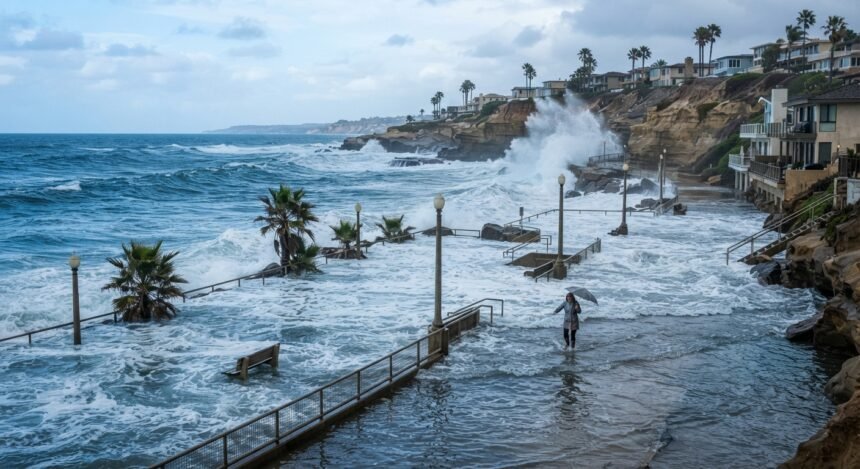
Seawater didn’t just reach the California coast this week—it reclaimed parts of it. From the San Francisco Embarcadero to the low-lying streets of Newport Beach, “King Tides” pushed the Pacific Ocean into parking lots, onto boardwalks, and inside garages, setting new local records for water levels.
These aren’t just seasonal anomalies. They’re a preview of a permanent shift in the state’s geography.
In San Francisco, tide gauges hit seven feet, a height that usually requires a massive storm surge to reach. This time, the sky was clear. The flooding was driven by the moon’s closest approach to Earth, but it’s the rising baseline of the ocean that’s doing the heavy lifting. Scientists at the Scripps Institution of Oceanography point out that as sea levels rise, the “record” tides of 2024 will likely be the daily high-water marks of 2050.
The impact was immediate and messy. In Santa Cruz, the swell surged over sea walls, forcing police to cordoning off West Cliff Drive. In Southern California, Huntington Beach residents spent the morning stacking sandbags against a tide that seemed determined to ignore the sand.
“We’re past the point of calling these ‘once-in-a-decade’ events,” says Sarah Edwards, a coastal researcher who monitored the surge in San Diego. “The ocean is moving into places where we used to build houses. It’s not a matter of if the water comes back, but how much more of the street it takes next time.”
The math is simple and grim. State agencies project an extra foot of sea-level rise along the California coast within the next three decades. That foot of water turns a nuisance flood into a structural disaster. For cities like Imperial Beach, which already struggles with drainage during high tides, the future looks increasingly underwater.
Coastal planners are now forced to choose between two expensive options: build higher walls or move back. While some cities are pouring millions into “managed retreat” strategies—essentially buying out homeowners and moving infrastructure inland—others are doubling down on sea walls that may only buy them a few more years.
The tides will recede by the weekend, but the damage to the coastline is cumulative. Every surge weakens cliffs and erodes the beaches that drive California’s multi-billion-dollar coastal economy.
The water is coming. This week proved that even on a sunny day, the Pacific can still shut down a city.