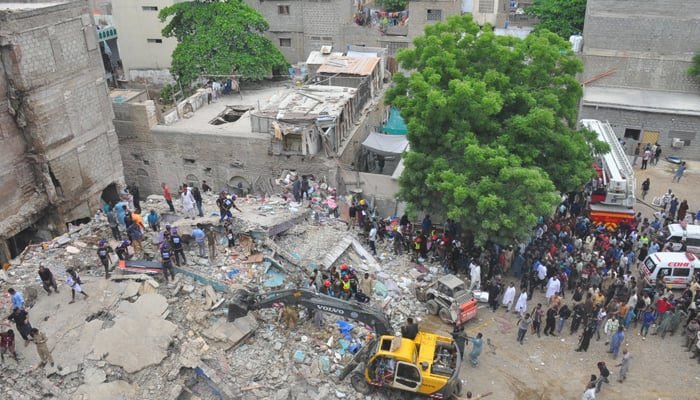
KARACHI — A devastating building collapse in Lyari’s Baghdadi area has once again raised pressing questions about Karachi’s aging infrastructure, rampant illegal construction, and government inaction. The five-storey residential building, declared dangerous years ago, collapsed on Friday, leaving 14 people dead, including five women, eight men, and a seven-year-old boy, while at least 25–30 individuals are feared to be trapped beneath the rubble.
What Happened?
According to Karachi Mayor Murtaza Wahab, the building — constructed in 1974 — was already marked as unsafe by the Sindh Building Control Authority (SBCA). Yet, despite several eviction notices, residents continued to live in the structure. “More than 400 buildings in Karachi have been declared dangerous. But persuading people to evacuate is often ignored,” the mayor said. “Today’s tragedy proves that when the government issues a warning, it must be taken seriously.”
Due to the building’s location in a tightly packed compound, adjacent two- and seven-storey structures had to be evacuated. Rescue teams, using heartbeat-detection devices, continue their painstaking search for survivors — a mission likely to stretch into the night under floodlights.
Past Incidents: A Disturbing Pattern
This isn’t the first such incident in Karachi. The city has witnessed multiple building collapses in recent years:
-
In 2020, a building collapse in Gulbahar (Golimar) claimed 17 lives.
-
In 2019, Rizvia Society saw a four-storey building collapse, killing 10.
-
In 2012, over 20 people died in a six-storey building collapse in Liaquatabad.
Each time, public outrage followed by promises and inquiries filled the air — only to be forgotten until the next tragedy struck.
How Many Live in Dangerous Buildings?
According to the SBCA, at least 578 buildings across Karachi are currently listed as structurally unsafe — with the majority in District South, including Lyari, Saddar, and Garden areas.
Research shows that 18% to 22% of Karachi’s population lives in illegal or deteriorating multi-storey buildings, many built on plots as small as 60 square yards, often without proper engineering or safety clearance. These are ticking time bombs scattered across one of the world’s most populous cities.
Emergency Response & Government Reaction
Rescue 1122, Rangers, police, and city wardens have sealed the area. The use of Trapped Person Locators is helping detect survivors deep under the debris. Rescue teams are working tirelessly, and the Deputy Commissioner of South Karachi confirmed that six families were inside the building at the time of collapse.
Sindh Local Government Minister Saeed Ghani has ordered an investigation committee, which will submit a report within three days. Several SBCA officials, including the Director, Deputy Director, and inspectors, have already been suspended.
National Condolences & Political Reactions
President Asif Ali Zardari and Prime Minister Shehbaz Sharif expressed grief over the loss and directed swift relief efforts. National Assembly Speaker Ayaz Sadiq extended condolences and called for the best medical treatment for the injured.
Meanwhile, Jamaat-e-Islami Karachi Emir Munim Zafar visited the scene and harshly criticized the SBCA. “Karachi is turning into a jungle of concrete under the patronage of a corrupt system. Buildings are rising illegally, five storeys high, on tiny plots — and the authorities look away.”
He claimed over 100,000 buildings have been built in Karachi over the last five years without proper approvals.
The Bigger Question: Who Is Responsible?
Every tragedy is followed by the same cycle: media outrage, temporary suspensions, investigation committees — and then silence.
The core issues remain:
-
No enforcement of evacuation orders
-
Rampant illegal construction with political backing
-
No digitized monitoring or approval system
-
Zero accountability of SBCA officials and builders