
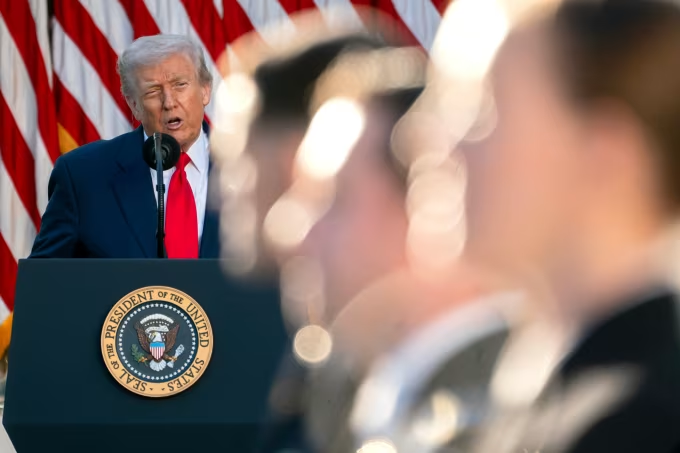
Former U.S. President Donald Trump, who once championed the slogan “America First,” now appears to be pursuing a more personal agenda “Trump First” as he increasingly extends his influence across global affairs.
Despite promising to prioritize domestic interests, Trump has recently issued threats to disarm Hamas in Gaza, hinted at U.S. military involvement, and boasted about destroying a Venezuelan speedboat in his controversial anti-drug operation. He also offered a $20 billion bailout to Argentina, but only on the condition that its voters support his political ally, President Javier Milei.
At the same time, Trump has publicly discussed supplying Ukraine with Tomahawk missiles, a move that risks direct confrontation with Moscow contradicting his earlier warnings against U.S.-Russia escalation. Analysts believe such moves aim to restore his waning international prestige after Russian President Vladimir Putin dismissed his peace efforts.
Trump’s sudden enthusiasm for global involvement has confused many MAGA supporters, who expected him to focus solely on America’s domestic issues. During recent media appearances, his erratic remarks ranged from attacks on political rivals like Elizabeth Warren and Kamala Harris to boasting about financial settlements and mocking world leaders.
Just a day before, Trump had been praised as a statesman for mediating a ceasefire and hostage exchange between Israel and Hamas, only to revert to his confrontational and unpredictable tone in subsequent statements.
While his foreign policy often defies logic and law, a clear pattern emerges — one driven by personal power, financial ambition, and global visibility rather than ideological consistency. Trump now seems less an isolationist and more a self-styled global strongman seeking dominance in world politics.
Experts describe his strategy as “transactional nationalism,” where diplomatic actions are often tied to personal or economic gains. His Middle East initiatives, for instance, appear motivated by business opportunities in reconstruction and access to rare minerals. Similarly, his involvement in Argentina and Venezuela reflects his growing interest in right-wing populist alliances.
During his 2016 campaign, Trump vowed to put “America First” opposing globalism and focusing on U.S. interests. However, in his second term, he seems to be rewriting that promise, pursuing prestige, power, and legacy over traditional diplomacy.
In essence, Trump’s foreign engagements have evolved from protecting America’s interests to protecting his own blurring the line between national policy and personal ambition.