

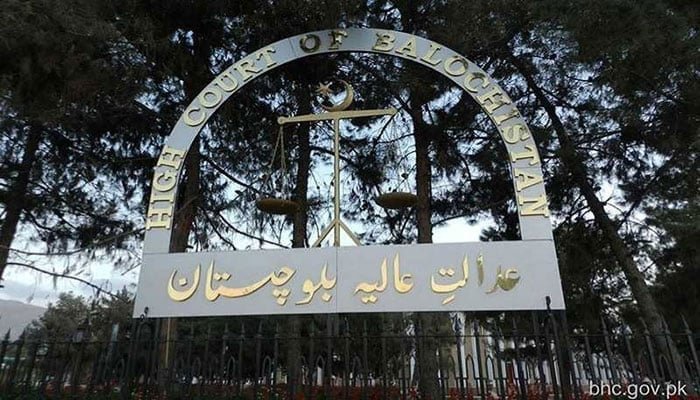
QUETTA — The Balochistan High Court has issued a landmark ruling declaring that prisoners convicted under the Anti-Terrorism Act (ATA) 1997 are not entitled to any form of general or special pardon.
A two-member bench comprising Justice Muhammad Kamran Khan Mulakhail and Justice Najamuddin Mengal dismissed multiple constitutional petitions filed between 2023 and 2024, ruling that Section 21-F of the ATA allows no interpretation or relaxation for terrorism convicts.
The court clarified that the 2001 amendment introducing Section 21-F was a deliberate measure to exclude terrorists from the scope of clemency, aimed at safeguarding public security amid rising terrorism. The judges emphasized that the ATA, as a special law, overrides general laws including the Jail Act of 1894.
Rejecting the argument that denying clemency violates Article 25 of the Constitution (equality before law), the court held that terrorism convicts form a distinct legal category, making such differentiation constitutionally valid.
The bench ordered the Home Department and prison authorities to revoke all unlawful remissions granted to terror convicts and to reassess their sentences. Officials were further warned of disciplinary action for any future violations.
The court also directed that all prisoners, regardless of class, must serve at least two-thirds of their original sentence as required under Pakistan Prison Rules 1978. Additionally, it instructed the Inspector General of Prisons to review the “B-Class” privileges granted to certain inmates and present a province-wide list before the court.
The judgment concluded that granting excessive remissions and privileges to serious offenders violates constitutional principles of justice and equality.