
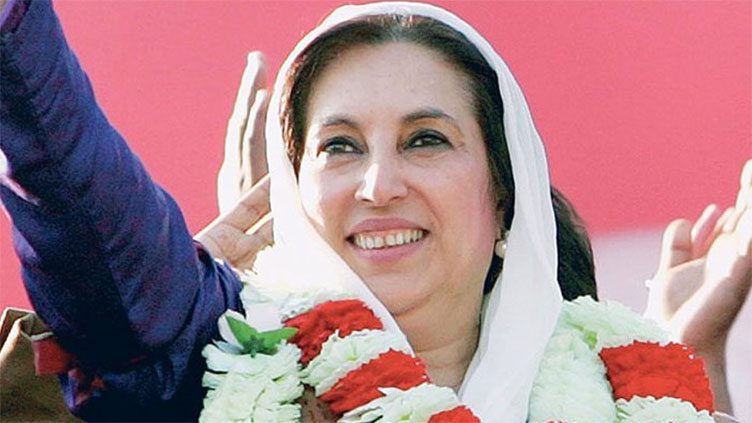
RAWALPINDI: Nearly two decades after the assassination of former prime minister Benazir Bhutto, Pakistan’s justice system is still struggling to bring closure to one of the country’s most tragic and defining crimes. Despite multiple investigations, long trials and several appeals, the case remains stuck in courts, leaving unanswered questions and deep public frustration.
Benazir Bhutto, known as the “Daughter of the East” and Pakistan’s first woman prime minister, was assassinated on December 27, 2007, moments after addressing a public rally at Rawalpindi’s historic Liaquat Bagh. As she left the venue, she was first shot at and then killed in a suicide bombing. The attack also claimed the lives of 27 Pakistan Peoples Party (PPP) workers and injured 98 others.
As PPP leaders and workers mark her death anniversary each year at the assassination site, the long legal battle continues without a final verdict. Although the PPP ruled the country for eight years after her killing, the party failed to conclusively identify or punish those believed to be behind the attack.
The murder case spent around ten years before a special Anti-Terrorism Court and has now remained pending for another eight years at the Rawalpindi bench of the Lahore High Court (LHC). Court records show that between January 1, 2024, and December 27, 2025, the case was not fixed for hearing even once, with little hope of progress before the end of January 2026.
The assassination marked the second killing of a prime minister at Liaquat Bagh, the same ground where Pakistan’s first premier, Liaquat Ali Khan, was murdered in 1951. Despite the scale of the tragedy, neither the Bhutto family nor the PPP became the complainant in the case, forcing the police to register and pursue it on their own.
Over the years, the case went through four major inquiries by the United Nations, Scotland Yard, Punjab Police and the Federal Investigation Agency (FIA). In total, seven challans were submitted, 12 judges were changed, 291 hearings were held and statements of 57 witnesses were recorded. The complexity of the trial deepened when senior prosecutor Zulfiqar Chaudhry was himself assassinated on a hearing day.
In August 2017, after a decade-long trial, Anti-Terrorism Court Judge Muhammad Asghar Khan announced the verdict. Five accused were acquitted and described as scapegoats, while two senior police officers former Rawalpindi police chief Saud Aziz and SP Khurram Shehzad were convicted for negligence and sentenced to 17 years in prison each. Both later secured bail and remain free.
Former president and military ruler Pervez Musharraf, named as the eighth accused, was declared a proclaimed offender after repeatedly failing to appear before the court. Arrest warrants, asset confiscation orders and extradition requests were issued, but none were implemented. Musharraf later died in Dubai, effectively closing that chapter without a trial.
Today, 12 different appeals linked to the case are pending before the Lahore High Court, including challenges to acquittals and convictions. Legal experts say the prolonged delays have weakened public trust in the justice system.
PPP’s legal representative, senior advocate Asad Abbasi, said the party would soon file an application for early hearings after court holidays. He insisted that the struggle for justice would continue. “Justice has been delayed, but it has not ended,” he said. “The truth behind Benazir Bhutto’s murder will one day come out.”
Eighteen years on, Benazir Bhutto’s assassination remains more than a historical tragedy it stands as a symbol of unresolved justice, reminding the nation that some wounds cannot heal until the truth is fully revealed.