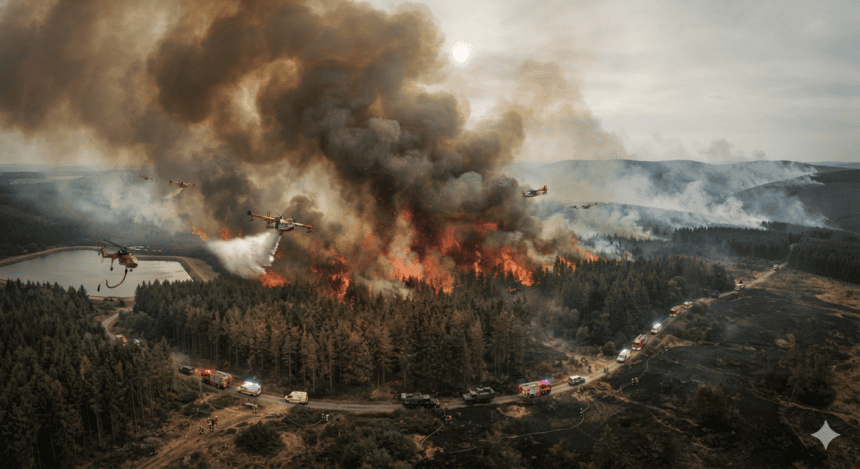
The High Fens, a sprawling nature reserve on Belgium’s eastern frontier, is currently the site of the country’s largest wildfire on record. Flames have consumed over 1,500 hectares of peatland and forest since Tuesday, pushing authorities to declare a state of emergency as the fire line edges closer to the German border.
Strong winds and a prolonged dry spell have turned the region’s unique, carbon-rich soil into a tinderbox. Fire crews from both Belgium and Germany are working in tandem, though the terrain is proving difficult. The area is largely inaccessible to heavy trucks, forcing firefighters to rely on aerial water drops and hand tools to carve out firebreaks.
The environmental cost is already mounting. The High Fens—or *Hautes Fagnes*—serves as a critical carbon sink. Ecologists warn that the fire isn’t just destroying trees; it’s burning through layers of peat that have been accumulating for thousands of years. Once this peat ignites, it becomes notoriously difficult to extinguish, often smoldering underground for weeks.
“We are fighting a beast that doesn’t just burn on the surface,” said Marc Vandeven, a regional emergency coordinator. “It’s eating the ground beneath our boots, and the wind is doing us no favors.”
Local authorities have evacuated three villages near the border, moving roughly 400 residents to temporary shelters in Eupen. While no casualties have been reported, the thick, acrid smoke has triggered air quality warnings as far away as Aachen, Germany.
The crisis has reignited a fierce political debate regarding climate resilience in the Ardennes. Despite warnings from the Royal Meteorological Institute about extreme fire risks earlier this spring, local infrastructure for rapid response remained limited. Critics argue the government was too slow to deploy specialized equipment capable of navigating the marshy terrain.
By Thursday afternoon, the blaze had reached within two kilometers of the German municipality of Monschau. German authorities have closed several major transit routes to allow for the movement of heavy water tankers and firefighting personnel.
Meteorologists expect the wind to shift slightly overnight, providing a narrow window for crews to contain the northern flank. However, with no rain forecast for the next 72 hours, the risk of the fire jumping the border remains high. The High Fens may survive the heat, but the landscape will likely be scarred for a generation.