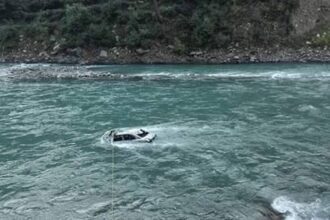

Communities across Gilgit-Baltistan (G-B) are slowly rebuilding their lives after deadly flash floods killed 41 people, injured over 100, and damaged more than 1,200 houses, bridges, and roads. As part of recovery efforts, the G-B government has formed joint verification teams to monitor flood rehabilitation projects and ensure transparency and quality of public works.
These floods triggered by heavy monsoon rains and glacial lake outburst floods (GLOFs) swept away over 100 bridges and nearly 450 km of roads, severely affecting tourism and local livelihoods across the mountainous region.
Chief Minister Haji Gulbar Khan said the scale of destruction was beyond the provincial government’s capacity. He appealed to the federal government and the Aga Khan Development Network (AKDN) for support in speeding up restoration work. The newly-formed teams will inspect ongoing projects, check technical accuracy, identify gaps, and submit detailed reports.
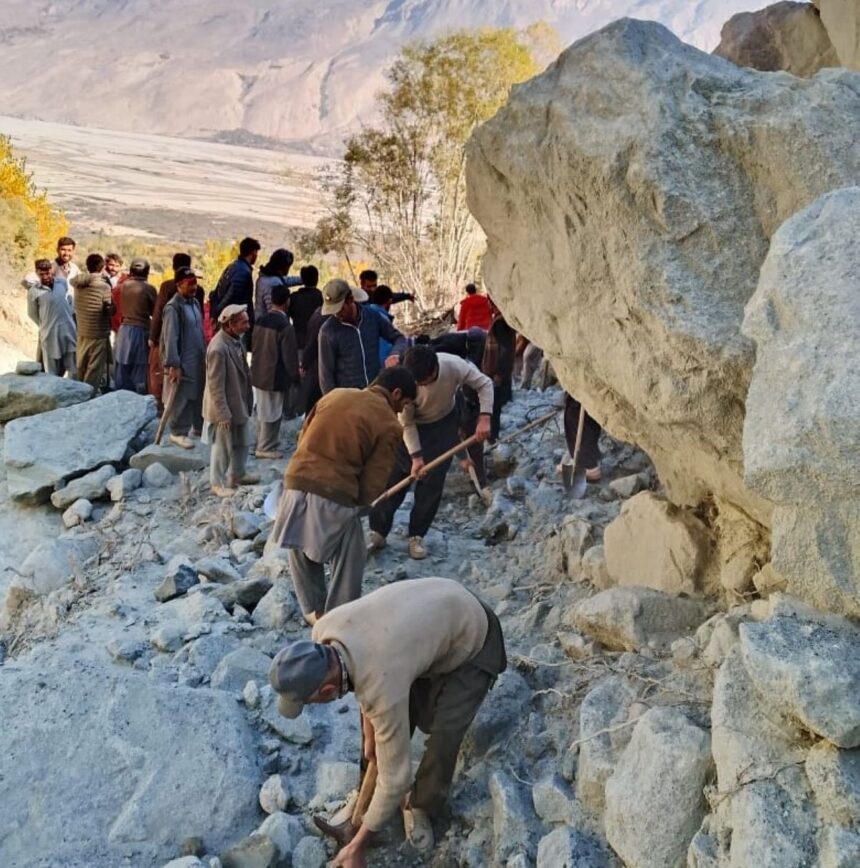
In Shigar Valley’s Kayo Gulapur area, villagers with help from the Aga Khan Rural Support Programme (AKRSP) have started rebuilding their destroyed irrigation channel crucial for farming and survival. “This channel is our lifeline,” said local farmer Sajjad Hussain, explaining how the floods dried their farmlands and threatened their next crop. “Restoring it has brought back our hope.”
AKRSP’s broader programme covers Gilgit-Baltistan and Chitral under the BRAVE initiative, supported by the UK’s Foreign, Commonwealth & Development Office (FCDO). The project focuses on rebuilding 162 irrigation channels, link roads, and bridges while providing agricultural aid to over 400 affected households.
So far, water channels are being repaired in districts including Ghanche, Ghizer, Hunza, Nagar, Skardu, Diamer, Shigar, Gilgit, and Chitral. Bridges in Chitral, Diamer, Ghizer, and Ghanche are also being restored.
“These small infrastructures water channels, roads, bridges are the arteries of mountain life,” said an AKRSP official. “Without them, everything stops farming, trade, and movement.”
Despite being one of the world’s most climate-sensitive regions, home to massive glaciers and unpredictable weather, the people of Gilgit-Baltistan are showing courage and resilience. “The floods washed away our crops, our roads, and our confidence,” shared Fatima Bano from Ghizer Valley. “But working together, we realised that unity can rebuild even after the worst disasters.”
With community spirit, support from NGOs, and government oversight, G-B is slowly moving from ruin to recovery proving that hope flows even after the harshest storms.