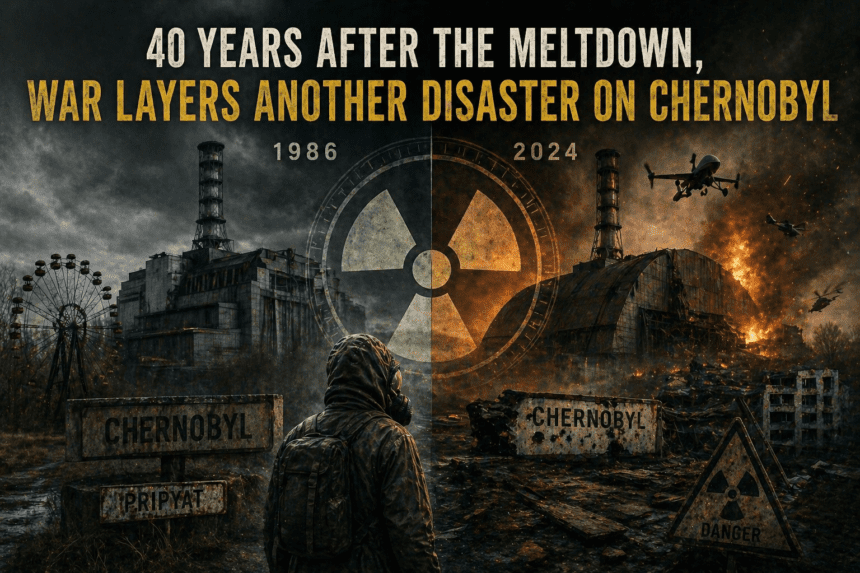
Forty years after the reactor explosion that made Chernobyl a global symbol of nuclear catastrophe, the site is once again being described in the language of danger. This time, the threat is not a reactor meltdown, but war. On the anniversary of the 1986 disaster, Ukrainian officials, engineers and international observers are warning that Russia’s invasion has layered a new crisis onto a place that was never meant to face another one.
The anniversary arrives with fresh damage still hanging over the site. In February 2025, a Russian drone struck the New Safe Confinement, the huge arch-shaped structure built to cover the ruined reactor and contain radioactive material. Ukrainian officials said the strike caused significant harm, and recent reporting says the repairs could cost at least €500 million, underscoring how even a single attack can create massive technical and financial consequences at one of the world’s most sensitive nuclear locations.
That is what makes the current moment so unsettling. Chernobyl was supposed to be a sealed chapter of history — heavily monitored, internationally managed, and slowly stabilized over decades. Instead, the war has turned it back into an active security concern. The Associated Press reported on April 26, 2026, that the anniversary has sharpened fears about attacks around nuclear infrastructure, while other coverage described Chernobyl as a site where the legacy of Soviet disaster now collides with the realities of modern warfare.
The symbolism is hard to miss. In 1986, the disaster exposed the cost of secrecy, technical failure and delayed truth. In 2026, the danger comes from militarization, drone strikes and the basic fact that no nuclear site — even one wrapped in steel and concrete — is truly insulated from a nearby war. That does not mean Chernobyl is on the verge of another reactor-scale catastrophe. It does mean the assumptions behind its long-term protection no longer look as solid as they once did.
Officials and specialists have been careful not to overstate the immediate radiological danger, but they are clearly not treating the damage as routine. The New Safe Confinement was designed as a multidecade protective barrier over Reactor 4, and any breach or serious structural damage matters because the system is central to containing contamination and enabling future dismantling work. The challenge now is not just repairing steel and outer layers. It is restoring confidence that the site can be protected in a war zone at all.
For Ukraine, the anniversary is no longer only about memory. It is about vulnerability. The exclusion zone remains a place haunted by the past, but the past is no longer the whole story. Four decades after the meltdown, Chernobyl stands as a reminder that technological disasters do not always stay in history; sometimes politics and war drag them back into the present.