

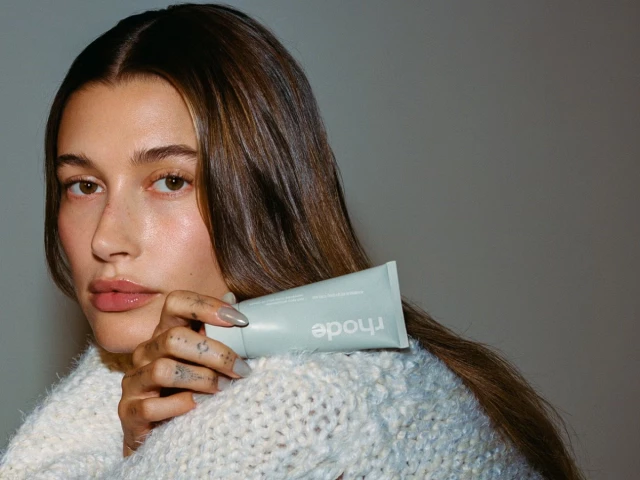
Hailey Bieber’s skincare brand, rhode, is facing its first major setback since being acquired by e.l.f. Beauty, as the company reported lower-than-expected sales for the recent quarter — sending e.l.f.’s stock tumbling nearly 7%.
According to a company filing, rhode brought in $40.2 million in revenue for the quarter ending June 30, 2025 — a solid figure on paper, but still shy of Wall Street expectations. The results came just months after e.l.f. acquired rhode in a billion-dollar deal meant to strengthen its position in the premium skincare space.
“While rhode continues to deliver strong gross margins, sales performance fell short of our internal projections,” an e.l.f. spokesperson said, noting that integration efforts and product expansion are “on track.”
A Setback for a $1 Billion Bet
When e.l.f. Beauty acquired rhode earlier this year, it wasn’t just buying a skincare brand — it was buying into Hailey Bieber’s image: minimalist, polished, and social-media-savvy. Her “glazed donut” aesthetic became viral gold on TikTok, pushing products like the Peptide Lip Treatment and Barrier Restore Cream to cult status.
Analysts expected the acquisition to boost e.l.f.’s fiscal 2025 earnings per share. But the softer-than-expected performance has investors worried the company may have overpaid for celebrity appeal that doesn’t immediately translate into steady revenue.
Shares of e.l.f. Beauty (NYSE: ELF) dropped roughly 7 % after the announcement, erasing part of the stock’s gains from earlier this year.
Analysts Urge Patience, But Pressure Builds
Industry watchers say this isn’t necessarily a sign of trouble — yet. Beauty mergers often take time to fully show their impact. But with macroeconomic pressure and changing consumer habits, investors are more cautious.
“Celebrity brands can drive huge short-term hype, but sustaining growth is the real test,” said retail analyst Maya Gonzalez of MorningStar. “Rhode still has strong brand equity, but scaling it under a larger corporate umbrella is a delicate process.”
Some analysts also point to global trade uncertainties and shifting tariffs that could be affecting e.l.f.’s overall guidance.
The Bigger Picture: Celebrity Brands Under the Microscope
Rhode’s stumble highlights a larger trend in the beauty industry. Even high-profile celebrity-backed brands — from Rihanna’s Fenty Beauty to Selena Gomez’s Rare Beauty — are being judged less on star power and more on consistent profitability.
Bieber’s brand, launched in 2022, built a loyal online following for its clean formulas and accessible luxury vibe. But integrating into e.l.f.’s mass-market model may require new pricing, distribution, and strategy adjustments.
What’s Next
e.l.f. Beauty said it remains committed to “growing rhode as a global prestige brand” and expects new product launches later this year to help offset slower early-quarter sales.
Still, for now, investors will be watching closely to see if Hailey Bieber’s glossy skincare empire can deliver the kind of results Wall Street expects — not just social media buzz.