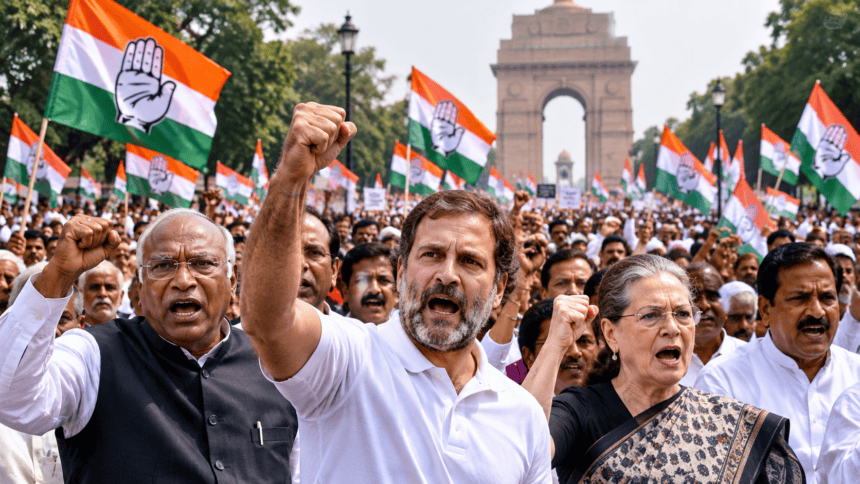
NEW DELHI — Thousands of Congress party workers swarmed the streets of central New Delhi on Monday, bringing traffic to a standstill as they marched toward Parliament to protest against the ruling Bharatiya Janata Party (BJP).
The protest, led by senior party figures including Mallikarjun Kharge and Rahul Gandhi, centered on rising unemployment, inflation, and what the opposition describes as the “systematic erosion” of democratic institutions. Police barricades lined the protest route, and heavy security deployments turned the capital’s diplomatic enclave into a fortress.
For the Congress, the optics were as important as the policy demands. The party has struggled to regain its footing since the 2014 rise of Prime Minister Narendra Modi. By filling the streets of the capital, they aimed to signal that their grassroots machinery still has teeth—and that the BJP’s grip on the national narrative isn’t as absolute as election results suggest.
“We are not just here for a day,” said one party official, speaking over the roar of the crowd. “We are here because the middle class is shrinking, and the government is busy rebranding failure as success.”
The government, meanwhile, dismissed the demonstration as a desperate political stunt. A BJP spokesperson labeled the protest a “distraction” intended to shield the Gandhi family from ongoing federal investigations into financial irregularities.
The divide highlights a hardening political climate. As the Congress attempts to pivot toward a more aggressive, street-level opposition strategy, the BJP remains locked in its focus on electoral consolidation.
The demonstration eventually dispersed as evening hit, leaving behind a city choked with traffic and a political landscape that feels more polarized than it did at sunrise. Whether this surge of energy translates into sustained momentum for the opposition remains the missing piece of the puzzle. For now, the Congress has made its noise—but in New Delhi, noise is rarely enough to change the direction of policy.