By using this site, you agree to the Privacy Policy and Terms of Use.
Accept
Media HydeMedia Hyde
  • Home
  • Politics
  • Education
  • Entertainment
  • Sports
  • Blogs
  • Business & Commerce
  • Others
    • Religious
    • Metropolitan
    • Climate and Weather
Font ResizerAa
Media HydeMedia Hyde
Font ResizerAa
  • Home
  • Politics
  • Education
  • Entertainment
  • Sports
  • Blogs
  • Business & Commerce
  • Others
    • Religious
    • Metropolitan
    • Climate and Weather
Follow US
© 2026 Media Hyde Network. All Rights Reserved.
internationalWorld

Japan’s Nankai Trough Fears: Why Experts Are Bracing for the “Big One”

Last updated: April 22, 2026 4:06 pm
Ayan Ahmed
Share
SHARE


Tokyo is built for tremors. Skyscraper dampers, rigorous building codes, and an ingrained cultural readiness mean most earthquakes in Japan result in little more than a rattled coffee cup. But the Nankai Trough—a massive subduction zone stretching along the country’s Pacific coast—is different. Seismologists have long warned that a rupture here could trigger a disaster far beyond the scale of standard seismic events.

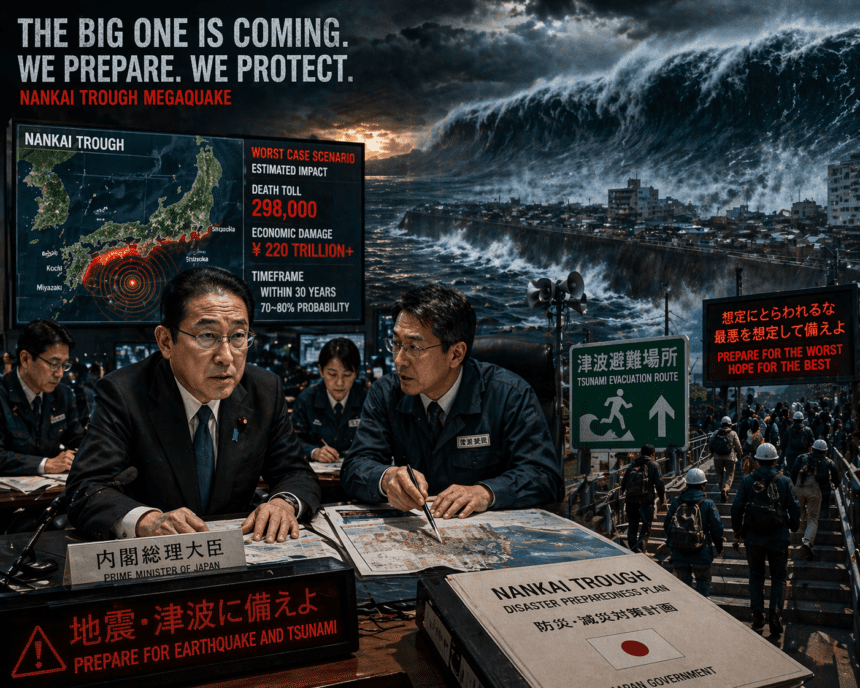
The Japan Meteorological Agency issued its first-ever “Megaquake Advisory” in August following a 7.1 magnitude tremor off the coast of Miyazaki. While the advisory was lifted a week later, the underlying threat remains. Government models suggest a worst-case scenario could trigger a magnitude 9.1 quake, potentially impacting 30 prefectures and leaving over 200,000 dead.

The math is grim. The Nankai Trough has historically ruptured every 100 to 150 years. The last major events occurred in 1944 and 1946; we are now deep into the window for a repeat.

“It is not a matter of if, but when,” says Dr. Toshitaka Katada, a disaster prevention expert at the University of Tokyo. He argues that Japan’s high level of preparedness—while impressive—creates a dangerous psychological buffer. “People believe the infrastructure will save them. But a tsunami of this magnitude will overwhelm even our best sea walls.”

The economic stakes are equally staggering. A full-scale rupture could cost the Japanese economy an estimated 220 trillion yen—roughly double the initial damage projections for the 2011 Tohoku earthquake. Supply chains would fracture instantly, and the industrial heartland along the Pacific belt, home to major manufacturing hubs, would face a near-total blackout.

Local governments are now racing to update evacuation routes and stockpile resources. Yet, the challenge isn’t just engineering; it’s geography. In coastal towns like Kochi, the projected tsunami arrival times are measured in minutes, leaving little room for error.

For the average resident, the advisory served as a wake-up call to check their “bosai” (disaster) kits. However, for the government, it confirmed a difficult reality: no amount of concrete can fully neutralize the power of a tectonic shift of this scale.

Japan knows the ground will move. The question now isn’t how to stop the earth, but how much of the country will be left to rebuild when the shaking finally stops.


Share This Article
Email Copy Link Print
Previous Article Sri Lankan government demands cricket board’s resignation after World Cup collapse
Next Article Iranian Rial Remains Volatile in Pakistan’s Informal Markets Amid Regional Tension
Leave a Comment

Leave a Reply Cancel reply

Your email address will not be published. Required fields are marked *

Sponsored Ads

Stay Connected

FacebookLike
XFollow
InstagramFollow
YoutubeSubscribe
WhatsAppFollow
ThreadsFollow
A Single Frame: How Gen Z Defined India’s New Wave of Dissent
Headline Politics
July 24, 2026
Trump’s Business Empire and the White House: A Collision of Interests
Headline Politics
July 24, 2026
Sonam Wangchuk ends 26-day hunger strike as government agrees to talks
Headline Politics
July 24, 2026
Stampedes and Closed Gates: Chaos Erupts at Iraq Border Crossings
Headline Politics
July 24, 2026
Environmental poliovirus detection declines across Pakistan, positivity falls to 13.1pc
Headline Health
July 24, 2026
New York’s Half-Trillion Dollar Bill: The Rising Cost of Staying Dry
Climate and Weather Headline
July 24, 2026

You Might Also Like

Volhynia Massacre Dispute Strains Poland-Ukraine Solidarity
Headlineinternational

Volhynia Massacre Dispute Strains Poland-Ukraine Solidarity

By
Haris Ali
international

White House orders security review following Trump assassination attempt

By
Amna Iqbal
Headlineinternational

Hezbollah chief says group’s weapons not part of talks with Israel

By
Haris Ali
Business & Commerceinternational

Headline: India’s energy pivot squeezes California at the pump

By
Ayan Ahmed
Media Hyde Media Hyde Dark
Facebook Twitter Youtube Rss Medium

About US

Media Hyde Network: Your instant connection to breaking stories and live updates. Stay informed with our real-time coverage across politics, tech, entertainment, and more. Your reliable source for 24/7 News.

Top Categories
  • Headline
  • Politics
  • Entertainment
  • Education
  • Sports
  • Religious
  • Metropolitan
  • Climate and Weather
Usefull Links
  • Contact Us
  • Disclaimer
  • Privacy Policy
  • Cookies Policy
  • Advertising Policy
  • Terms & Conditions

© 2025 Media Hyde Network. All Rights Reserved.

Welcome Back!

Sign in to your account

Username or Email Address
Password

Lost your password?