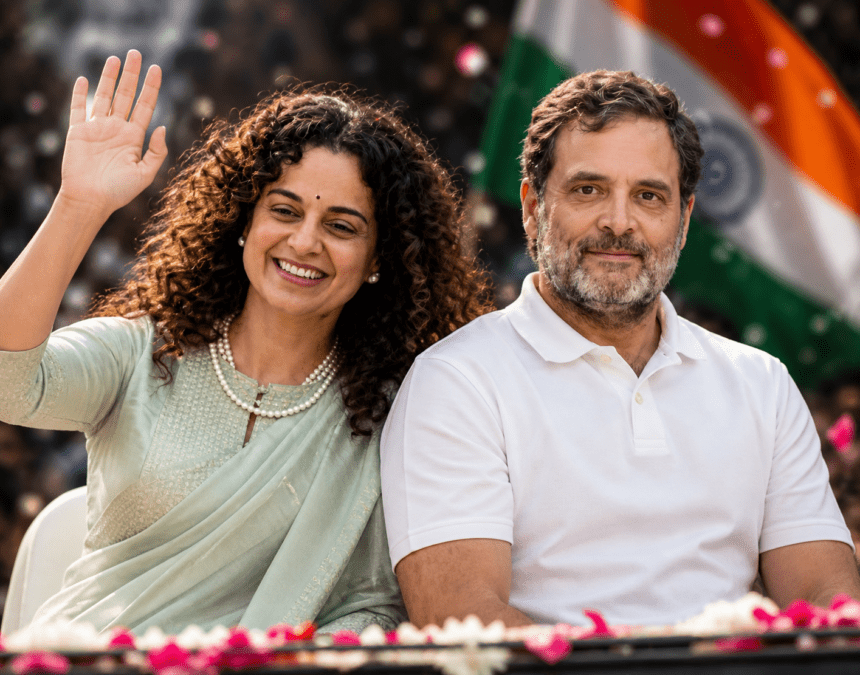
Actor-turned-politician Kangana Ranaut has pushed back against a viral social media claim that she said she would marry Congress leader Rahul Gandhi if he joined the BJP, calling the post “pathetic fake news” and accusing those behind it of dragging women through disrespectful public gossip.
The controversy appears to have started on May 3, when an Instagram meme page circulated a fabricated quote attributed to Ranaut. The post claimed she had said, in Hindi, that she would be ready to marry Gandhi if he switched to the Bharatiya Janata Party. The line spread quickly online, with users debating whether it was satire, sarcasm, or something she had actually said. It wasn’t.
Ranaut responded a day later on Instagram Stories, where she reposted the meme and rejected it outright. “How pathetic is this fake news, no dignity for women even in politics, shame on those who are spreading these fake news,” she wrote, making it clear she had never made the remark now being passed around as fact.
Her reaction did more than just swat down a rumor. It also tapped into something bigger, and frankly uglier, about the way women in public life are discussed online. Ranaut framed the episode as part of a broader pattern in which female politicians and public figures are mocked, sexualized, or trivialized for clicks. That, more than the meme itself, seems to be what genuinely irritated her.
The rumor also landed in a politically charged moment. Ranaut, now a BJP MP from Mandi in Himachal Pradesh, has been openly critical of Rahul Gandhi in recent months. In March 2026, she accused the Leader of the Opposition of behaving in Parliament in a way that made women MPs uncomfortable, and used the word “tapori” while attacking his conduct. Those remarks had already sharpened the political hostility between her and the Congress camp, which made the sudden circulation of a supposed “marriage” comment look even more implausible to many observers.
What gave the post traction, of course, is the fact that Ranaut has built a public image around saying the unexpected. She has long mixed celebrity, provocation and politics in a way that keeps her in the headlines. But this time, she drew a line. Her message was simple: don’t confuse a meme with a statement, and don’t turn a woman in politics into easy material for cheap virality.
For now, there has been no indication that Rahul Gandhi made any response to the viral claim or Ranaut’s denial. The episode instead stands as another reminder of how quickly misinformation can snowball online, especially when it involves celebrity politicians and ready-made political rivalry. In India’s social media ecosystem, a joke, a fake quote and a screenshot can become national conversation in a matter of hours.