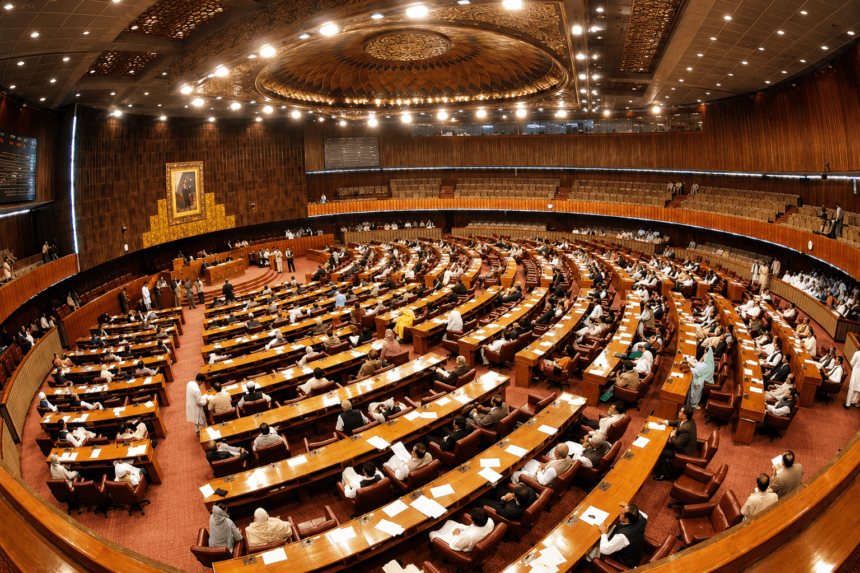
Pakistan’s National Assembly has passed two more government-backed measures, one tightening the legal route for banks to recover unpaid loans and another amending the Pakistan Airports Authority law. The bills — the Financial Institutions (Recovery of Finance) Amendment Act, 2026 and the Pakistan Airports Authority (Amendment) Bill, 2026 — moved through the lower house as part of a broader run of legislative business in May.
The banking bill is the one likely to get the closest scrutiny. Reporting on the finance committee’s proceedings shows lawmakers backed changes meant to “strengthen and streamline” foreclosure and recovery rules, with the stated goal of creating clearer procedures, tougher enforcement, and fewer delays in recovery cases. The committee also went clause by clause through a newly inserted Section 15A, discussing a sequence of first, second and final notices, each with a minimum 30-day period before further recovery action could begin.
That said, the debate around it wasn’t exactly one-sided. Committee members also raised concern about how far lenders’ powers should go, especially in housing finance cases. The panel discussed safeguards against what it described as arbitrary, coercive or unfair use of foreclosure powers, and its chairman stressed the need to keep a fair balance between financial institutions and borrowers. In plain terms: the government is trying to speed up recoveries, but lawmakers were clearly aware that a harsher process could hit ordinary borrowers hard if the legal guardrails are weak.
The airports bill is narrower in publicly available reporting, but the legislative move still matters. The Pakistan Airports Authority (Amendment) Bill, 2026 was introduced earlier in March as an amendment to the Pakistan Airports Authority Act, 2023, and it has now advanced through the National Assembly’s legislative pipeline. Accessible reports do not spell out the full text of the amendments, though the measure is being presented as part of ongoing institutional adjustments around aviation administration and airport governance.
The passage of these measures also fits a wider pattern in Islamabad. In recent sittings, the Assembly has been clearing a stack of economic and governance bills, including legislation tied to debt management, EXIM Bank governance and financial market rules. So this wasn’t an isolated afternoon in parliament; it was another sign that the government is pushing technical, systems-focused legislation while trying to show momentum on economic management and state-sector reform.
For banks, the recovery bill could eventually mean faster enforcement against chronic defaulters. For borrowers, especially those with mortgaged property, it could mean a more structured but potentially more unforgiving process once defaults begin. And for the aviation side, the airports authority amendment suggests the government still sees airport administration as an area that needs legal fine-tuning, even if the practical effects will only become clearer once the final text is examined more closely