
Party distances itself from full-page advertisement in US newspaper, as diaspora-led efforts spark debate over foreign lobbying
Pakistan Tehreek-e-Insaf (PTI) has denied any official involvement in funding a full-page advertisement published in The New York Times calling for the release of former prime minister Imran Khan, even as the party’s official accounts and overseas affiliates widely circulated and endorsed the campaign online.
The advertisement, which appeared in the August 2 edition of The New York Times, was headlined “Free Imran Khan” and claimed that the former premier had been detained under “unjust” and “inhumane” conditions for over 700 days. It also appealed to the US government to impose Global Magnitsky sanctions and uphold democratic and civilian supremacy in Pakistan.
While speculation grew about PTI’s direct role in financing the costly ad, party officials moved swiftly to clarify their position. PTI Information Secretary Sheikh Waqas Akram said the party had no financial connection to the campaign.
“I spoke with our team in the US and they categorically denied funding the ad. It appears to have been sponsored by members of the Pakistani diaspora, possibly a doctors’ group,” he told The News.
Despite denying involvement, PTI-affiliated social media accounts were quick to amplify the message. PTI USA’s official handle posted an image of the ad, stating: “The Pakistani diaspora community placed a full-page advertisement in the United States’ leading newspaper to raise awareness about Imran Khan’s arbitrary, politically motivated, and inhumane imprisonment.”
PTI’s main account in Pakistan also retweeted several posts highlighting the ad, including commentary by political analyst Hussain Nadim, who wrote: “Their wish is to make Imran Khan irrelevant and forgotten; ours is to make sure it remains a wish.”
PTI USA President Sajjad Burki appeared to endorse the initiative, thanking First Pakistan Global and the Pakistani-American diaspora for their support. “Full page in The NY Times about Imran Khan’s illegal detention, horrible living conditions, and demand for his release to the international community,” he tweeted.
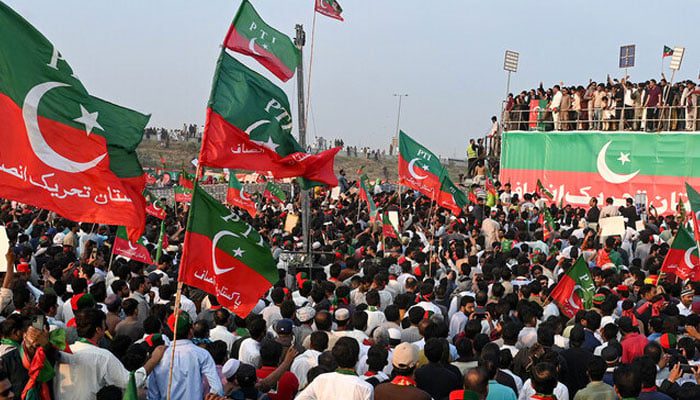
The advertisement, placed by First Pakistan Global in collaboration with Pakistani-American advocacy groups, was released just ahead of PTI’s planned nationwide protests scheduled for August 5.
Debate Over Funding and Messaging
The publication of the ad has prompted widespread debate, particularly over its cost and implications. With full-page ads in The New York Times known to cost tens of thousands of dollars, social media users questioned the source of funding. Some supporters defended it as a necessary advocacy tool, while critics labelled it a bid for foreign interference.
Veteran journalist Syed Talat Hussain took to X (formerly Twitter), remarking: “From ‘Absolutely Not’ to ‘Ad-solutely Yes’ PTI, Goldsmiths and Company have gone from rejection to reliance on American media to shape narratives. It’s a paid ad, not an op-ed. And by the way, Trump hates the NYT.”
The mislabeling of the ad as an editorial or op-ed by some supporters added to the controversy, with critics stressing that it represented a paid message rather than an endorsement by the newspaper itself.
Opponents also argued that appealing to the US government to intervene in Pakistan’s domestic affairs undermines the country’s sovereignty and contradicts PTI’s earlier stance of non-alignment and independence in foreign policy.
Protests Abroad Continue
Meanwhile, PTI supporters staged protests in cities across the United States, the United Kingdom, and Europe, echoing the demands highlighted in the advertisement. In London, demonstrators rallied outside 10 Downing Street, chanting slogans in support of Imran Khan and demanding his immediate release.
The campaign underscores the growing role of the Pakistani diaspora in shaping international narratives around domestic politics. However, it has also drawn criticism for appearing to bypass local democratic channels in favour of foreign lobbying.
As Pakistan continues to grapple with political tensions at home, the internationalisation of Imran Khan’s legal battle is likely to remain a contentious issue across both political and public spheres.