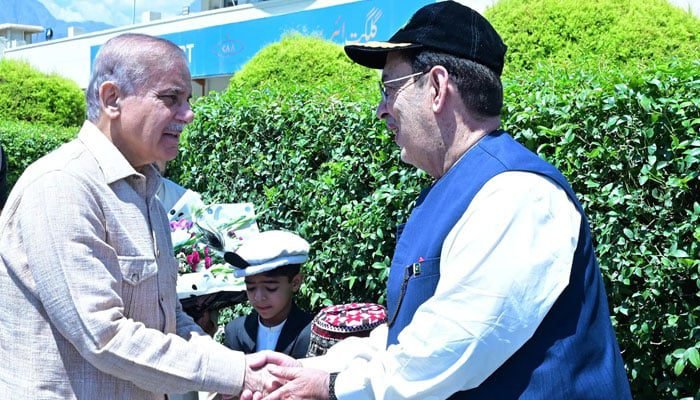
Prime Minister Shehbaz Sharif on Monday underscored the urgent need for climate resilience as he visited flood-affected areas of Gilgit-Baltistan (GB), where torrential rains and flash floods have caused significant loss of life and damage to infrastructure.
During his day-long visit, the premier was briefed by Governor Mehdi Shah on the extent of devastation caused by the recent rains. The visit follows a series of extreme weather events across the country, with monsoon floods claiming at least 299 lives nationwide including 140 children and displacing hundreds.
“I deeply regret the tragic loss of life and property caused by the heavy rains,” PM Shehbaz told reporters, adding that Pakistan’s minimal contribution to global carbon emissions makes its vulnerability to climate-induced disasters all the more unjust. “Despite near-zero emissions, we continue to suffer disproportionately from the effects of global warming,” he stressed.
The Prime Minister reiterated his government’s commitment to climate action, instructing the Ministry of Climate Change to proactively respond to such disasters. He emphasized the need for resilient infrastructure, particularly in vulnerable regions like GB, and called for stronger participation in global climate forums to secure international climate financing.
Chairing a high-level meeting in Diamir to assess the losses from the floods and cloudbursts, the prime minister directed federal and provincial authorities to intensify relief and rehabilitation efforts. He stressed inter-agency coordination and pledged full federal support to the GB government.
The visit also included discussions with GB Chief Minister Gulbar Khan on law and order, regional development, and the establishment of Daanish Schools to enhance educational access in the remote region.
According to officials, the Babusar Valley in GB experienced catastrophic flash floods last week, sweeping away tourists and vehicles. At least six lives were lost and several individuals remain missing. The GB government has since concluded a 14-day search and rescue operation, during which debris was cleared but no further missing persons were found.
Elsewhere in Chilas and Skardu, over 200 tourists were stranded as landslides blocked major routes, including parts of the strategic Karakoram Highway. The Pakistan Army and civil authorities carried out successful evacuations in the affected zones.
GB government spokesperson Faizullah Faraq confirmed the suspension of rescue efforts, stating: “Hopes of finding the missing persons have, sadly, faded.”
Meanwhile, the Pakistan Meteorological Department (PMD) has forecast another spell of heavy rainfall and potential cloudbursts in GB and Azad Jammu & Kashmir (AJK) from August 5 to August 7. July 2025 alone saw 23% above-average rainfall across the country, with GB receiving 20.2mm of rain a 52% increase over the normal monthly average.
Punjab also saw its eighth wettest July on record, receiving 163.5mm of rain — a 57% increase. A marginal temperature rise of 0.1°C was also recorded.
As climate risks continue to escalate, the prime minister concluded his visit by calling for sustained international cooperation and internal preparedness to tackle future challenges.