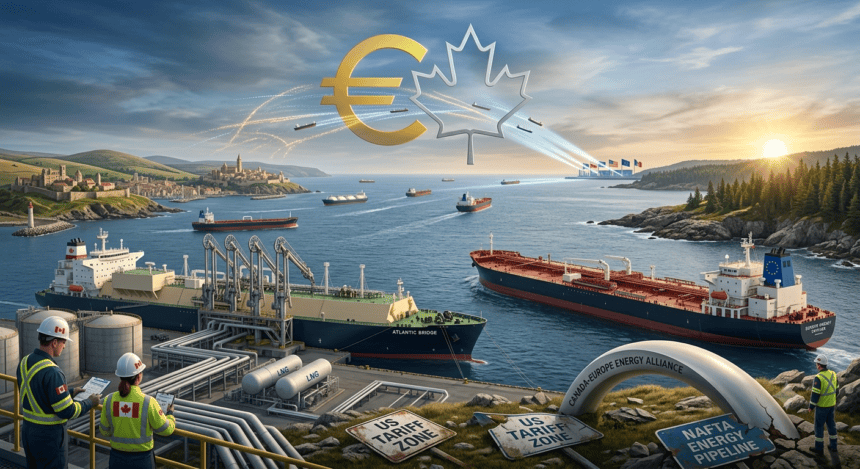
OTTAWA — Prime Minister Justin Trudeau is looking across the Atlantic to insulate Canada’s economy from the looming threat of U.S. tariffs. As President-elect Donald Trump threatens a 25% levy on all Canadian goods, the federal government is accelerating talks to ramp up energy exports to Europe.
The strategy is simple: diversify or suffer. With the U.S. taking roughly 75% of Canada’s exports, the Canadian government is pushing to position the country as a reliable, long-term energy partner for a Europe still reeling from the loss of Russian gas.
“We are not sitting on our hands,” a senior official in the Ministry of Natural Resources told reporters yesterday. “The reality is that our energy infrastructure needs to serve more than just one customer.”
The push centers on liquefied natural gas (LNG) and hydrogen. While Canada has historically struggled to get major export terminals off the ground due to regulatory hurdles and environmental opposition, the geopolitical stakes have changed. The federal cabinet is now reviewing fast-track options for two major projects in British Columbia and Quebec, hoping to signal to Berlin and Brussels that Canadian supply is ready to move.
For the Canadian energy sector, this is a long-overdue pivot. For years, industry leaders have argued that Canada’s inability to export to global markets left them at the mercy of U.S. pricing and policy whims. Now, that vulnerability is a national security concern.
Critics, however, remain skeptical. Environmental groups point to the carbon footprint of LNG, while energy analysts warn that building the necessary infrastructure takes years—far longer than the immediate threat posed by a Trump administration inauguration in January.
“Infrastructure is not built on promises,” said energy economist Sarah Jenkins. “Even if they break ground tomorrow, we are looking at 2028 before a single molecule of that gas hits a European port.”
The government is betting that the mere signal of a trans-Atlantic partnership will force Washington to reconsider its aggressive trade stance. If Canada can prove it has viable alternatives for its resources, the “captive market” leverage the U.S. currently enjoys begins to erode.
Trudeau heads to Washington next week, but his team is already laying the groundwork for a broader European tour. The goal is to sign binding commitments before the new U.S. administration takes the oath. Whether those deals can survive the political volatility remains the primary question for Canada’s economic future.