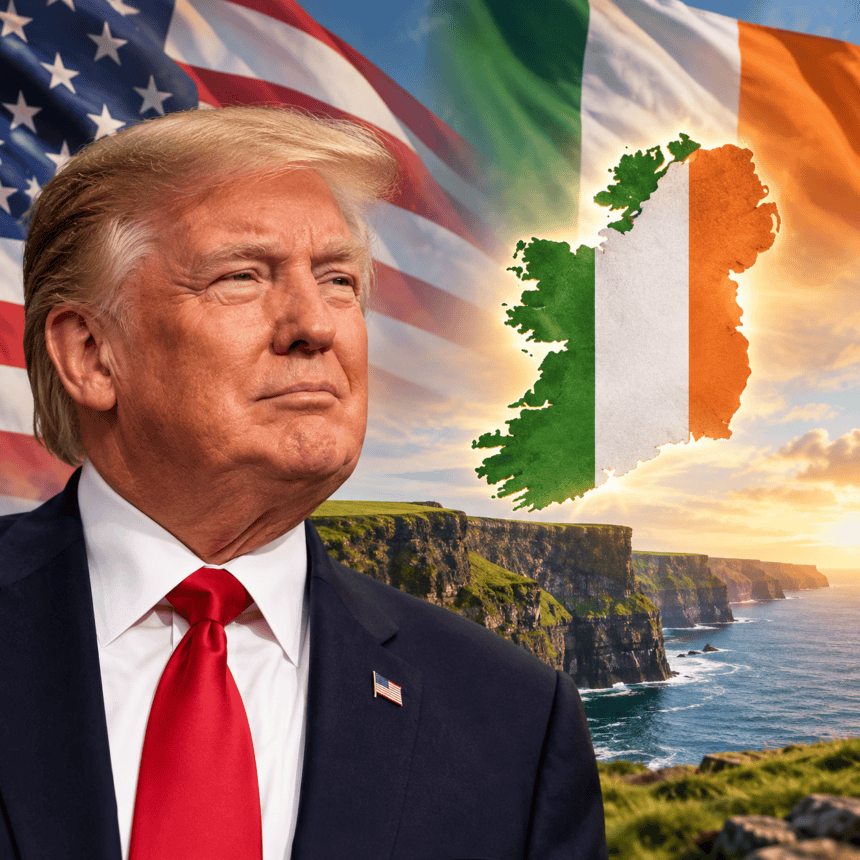
Donald Trump has signaled a radical shift in U.S. policy toward Northern Ireland, describing the potential for a unified Ireland as “fantastic.” The comments, delivered in a recent interview, represent a sharp departure from the long-standing American diplomatic tradition of neutrality regarding the constitutional status of the region.
For decades, U.S. administrations—both Republican and Democratic—have carefully walked a tightrope. They acted as guarantors of the Good Friday Agreement, pushing for stability while avoiding any stance that might alienate Unionists or provoke Nationalist fervor. Trump’s off-the-cuff endorsement effectively tosses that playbook out the window.
The reaction in Belfast was immediate. For the Democratic Unionist Party (DUP), the remarks are a dangerous provocation. They view the U.S. role as a mediator, not a partisan cheerleader for a border poll. To them, Trump’s words undermine the delicate balance that keeps the power-sharing government in Stormont from collapsing.
Conversely, Sinn Féin leaders have largely welcomed the rhetoric. They’ve spent years lobbying Washington, framing the unification debate as a natural evolution of the peace process. Having a figure with Trump’s influence label the prospect “fantastic” provides a massive rhetorical boost to their campaign for a border poll.
The move comes at a sensitive time. Post-Brexit trade frictions continue to strain relations between the U.K. and Northern Ireland, with the Windsor Framework still struggling to satisfy all sides. By weighing in so heavily, Trump has complicated the job for British officials who view the union as a domestic matter, not an international project for the U.S. to adjudicate.
Critics of the former president suggest the remark might be less about deep-seated geopolitical strategy and more about his tendency to embrace disruptive positions. Yet, for observers in Dublin and London, the intent matters less than the impact. The U.S. has long been the primary external architect of the Northern Irish peace process; when its most prominent political voice pivots, the regional power dynamics shift with it.
Whether this is a genuine policy pivot or merely a fleeting comment, it has already achieved one thing: it has forced a debate that many in the diplomatic corps were hoping to keep quiet until the political climate in Northern Ireland reached a more stable equilibrium.
“The peace process was built on the idea that the U.S. would be an honest broker,” says one London-based policy analyst. “When the broker starts picking sides, the deal doesn’t get stronger—it gets more fragile.”