
Imran Khan remains the party’s biggest strength – and its biggest weakness
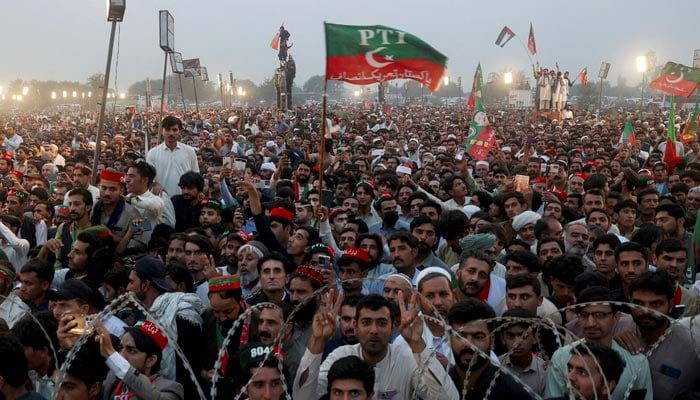
PTI supporters at a rally in Swabi on Nov 9, 2024. Reuters/File.
Analysts believe the Pakistan Tehreek-e-Insaf’s ongoing turbulence is less about structural disunity and more about Imran Khan’s deliberate strategy. The imprisoned party founder continues to exert tight control, ensuring loyalty but leaving the PTI in a state of strategic uncertainty.
At the center of the debate is whether PTI will contest upcoming by-elections or withdraw from parliamentary committees. While Aleema Khan, Imran’s sister, announced that members were directed to quit all National Assembly committees, reports suggest the political committee has leaned towards contesting by-polls.
PML-N leader Khawaja Asif criticized this dual approach, tweeting on Tuesday that PTI was eager to fight elections in KP, where it holds power, but hesitant in Punjab, where its defeat seems likely.
A Party Caught Between Strategies
Former senator Mustafa Nawaz Khokhar, now aligned with the opposition TTAP alliance, argues PTI should contest by-elections rather than boycott. “If they believe this government will face moral pressure as a result, they are mistaken. This administration, which emerged from a disputed election and accepted reserved seats after the controversial 26th Amendment, has no moral reservations. PTI must respond politically, not by withdrawal,” he told The News, warning that party workers seek unity, not division.
Journalist Azaz Syed sees the confusion as symptomatic of PTI’s dependence on its founder. “Imran Khan is PTI, and PTI is Imran Khan. He’s in jail but still beyond anyone’s control, while those outside are cautious, trying to keep him happy without risking arrest,” he said.
According to Syed, Imran is promoting a narrative of complete disengagement from parliamentary politics. “There’s serious consideration of resigning from both the National Assembly and Senate to delegitimize the system. But PTI has already paid a heavy price for earlier resignations,” he warned.
Loyalty vs Reality
This dynamic creates visible rifts. “Hardcore supporters defend every decision Imran makes,” Azaz observed, “but many MNAs quietly want to quit the party. They stay only because they fear backlash from supporters and social media.”
Veteran journalist Asma Shirazi believes the confusion is deliberate, not structural: “Every decision rests with Imran Khan. He creates ambiguity when it suits him. This helps him claim credit for success and shift blame for failure.” According to Shirazi, Imran’s disdain for parliamentary processes explains much of PTI’s disarray. “He rejects the cumbersome principles of accountability and procedure, preferring backdoor dealings with the establishment,” she noted.
A Party Without Structure
Shirazi argues PTI has no real organizational framework. “Even from prison, he micromanages the party. It’s been his strategy from the start — and quite effective in keeping control,” she said.
Barrister Ali Tahir, however, sees no ideological inconsistency in PTI’s stance: “Their anti-establishment narrative is clear and popular. The only ambiguity lies in electoral tactics.” He contends that quitting committees reflects a refusal to legitimize what PTI considers a biased system.
Conversely, Mehmal Safraz warns that isolation could shrink PTI’s political space: “Without a coherent strategy, the party risks further marginalization. Staying in the system would give PTI more leverage.”
Journalist Hassan Iftikhar frames the crisis as a clash between force and dialogue: “One camp believes in muscle power; the other advocates negotiation. The current disruptions aim to keep pressure high so Imran can secure release on favorable terms.”
Factionalism Deepens
Reports suggest competing influences within PTI, particularly between Aleema Khan and Bushra Bibi. Majid Nizami claims Aleema is pushing a more aggressive line. He cites the Punjab Assembly resignation as an example of costly miscalculations. “PTI had a strong position there, but surrendered it voluntarily,” he noted.
The Central Dilemma: Imran Khan
Every perspective circles back to Imran Khan’s dominance. For some, it ensures unity; for others, it stifles institutional growth. As Azaz Syed sums it up: “He is PTI’s greatest strength — and its greatest weakness. The irony is that Imran himself is powerful, but he doesn’t want the party to become more powerful than him.”