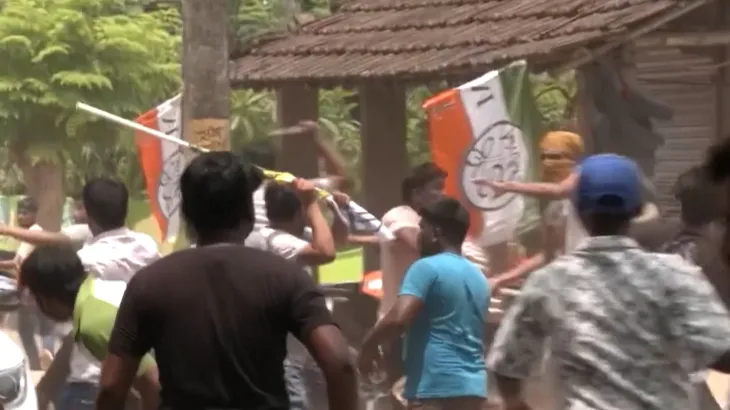
KOLKATA, April 23 — Voting in West Bengal’s first phase opened Thursday under a familiar cloud: heavy security, sharp political accusations, and, before the day had properly settled, fresh reports of clashes between rival party workers in parts of the state. In Murshidabad, one of the day’s flashpoints, workers linked to the ruling Trinamool Congress and supporters of Aam Janata Unnayan Party founder Humayun Kabir were involved in a confrontation that added to an already tense polling atmosphere. Reports from the ground also spoke of stone-pelting, vandalism and allegations of crude bomb attacks in and around the area.
The violence did not erupt in a vacuum. This election was always going to be bruising. Prime Minister Narendra Modi’s Bharatiya Janata Party is trying once again to break the Trinamool Congress grip on one of India’s biggest and most politically symbolic states, while Chief Minister Mamata Banerjee is fighting not just for another term, but for her standing as one of the opposition’s most important national figures. That larger battle was already intense; Thursday’s skirmishes made it feel even rawer.
Murshidabad drew particular attention after reports that a blast took place near Shibnagar in the Nawda assembly segment on the eve of polling. Local accounts said crude bombs were hurled near a road close to a polling station, injuring at least one woman and triggering panic ahead of voting. By polling day, tensions were still running high. When Kabir arrived in the area, a crowd confrontation followed, with security personnel stepping in as rival supporters shouted slogans and pushed toward one another.
Elsewhere too, the day was anything but calm. Live coverage from Indian outlets described scattered violence in several constituencies, including allegations that a BJP candidate was attacked and that Kabir’s convoy was vandalised. There were also complaints of proxy voting and intimidation, familiar charges in Bengal elections, where each side tends to accuse the other of trying to frighten voters or muscle into booths. Some of those claims may yet be contested or investigated, but the broader picture was already clear by midday: polling was active, turnout was strong, and nerves were badly frayed.
The Election Commission had prepared for a difficult day. Official election material showed West Bengal’s 294-seat assembly vote being held in two phases, with Phase 1 scheduled for April 23 and the second phase next week, while results are due on May 4. The Commission had also completed EVM randomisation ahead of voting, part of its standard preparations for a closely watched contest.
Yet procedure has not been the only issue hanging over this election. A major shadow over the campaign has been the controversial revision of electoral rolls. According to AP, about nine million names were removed from West Bengal’s voter lists after a nationwide revision, amounting to roughly 12 percent of the state’s electorate. The Election Commission has defended the exercise as a clean-up meant to remove duplicate, deceased or otherwise ineligible entries. Critics, including opposition leaders and civil society voices, say the process has swept up many legitimate voters and has disproportionately hit Muslims and other marginalised groups. That dispute has sharpened distrust around polling day itself.
Despite the tension, turnout moved briskly. Election trend updates carried by Indian media, citing ECINET data, showed West Bengal recording 78.77 percent turnout by 3 p.m. in Phase 1, a sign that voters were still turning out in large numbers even as violence and allegations swirled around parts of the state. In Bengal, that contradiction is hardly new. People show up. Politics boils over. Both things can be true at once.
For Mamata Banerjee’s Trinamool Congress, the test is whether it can convert organisation and incumbency into another comfortable mandate without letting street-level conflict define the race. For the BJP, the election is another shot at proving that Bengal’s political map is not fixed. Smaller regional players such as Kabir’s outfit may not dominate the statewide contest, but in sensitive districts they can still stir local equations and intensify already bitter rivalries.
As voting continues through the two-phase schedule, Thursday’s clashes are likely to deepen arguments over security, fairness and voter confidence. That, honestly, may be the bigger story beneath the scuffles. In West Bengal, election violence is never just about one fight on one road. It tends to signal something deeper — a contest so polarised that every booth, every convoy, every crowd becomes a small theatre in a much larger political war.