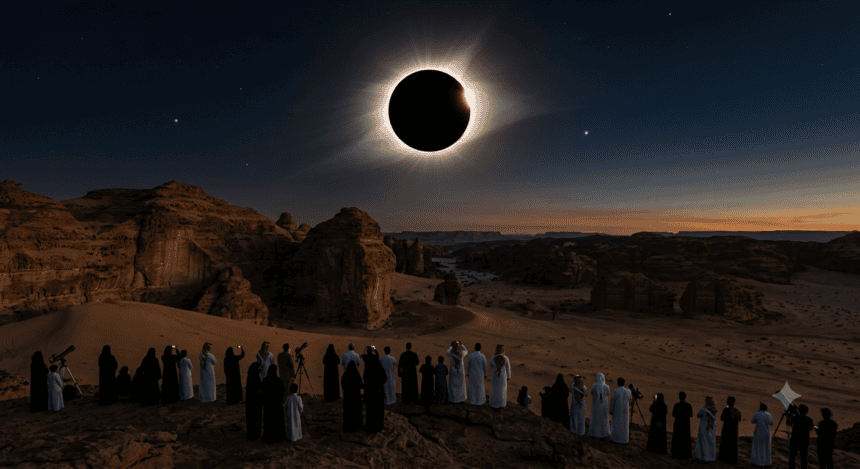
The moon will block the sun entirely over parts of Saudi Arabia in the coming years, marking the kingdom’s first total solar eclipse since 1952. For a nation synonymous with relentless desert heat and blinding sunlight, the phenomenon promises a brief, surreal plunge into midday darkness.
Astronomers have pinpointed the event for August 2, 2027. While total solar eclipses occur globally with some regularity, they are notoriously fickle, often tracking over oceans or sparsely populated wilderness. This path is different. It slices directly across the heart of the Middle East, with the Saudi city of Tabuk positioned to experience one of the longest durations of totality in the region.
The event holds significance beyond its scientific rarity. Saudi Arabia’s ongoing “Vision 2030” initiative has aggressively pushed the country as a global tourism hub. Officials and private tour operators are already coordinating to turn the eclipse into a major celestial event. Hotels in the path of totality are expected to see a surge in bookings from international “eclipse chasers”—a dedicated community of travelers who cross continents to stand in the moon’s shadow.
“This isn’t just an astronomical observation; it’s a logistical challenge and a massive opportunity,” said a regional climate researcher familiar with the planning. “You have thousands of people descending on desert locations that aren’t typically equipped for such an influx.”
Safety remains the primary concern for local authorities. Public awareness campaigns are being drafted to ensure residents understand the risks of viewing the sun without specialized solar filters. Past eclipses in the region have seen varying levels of public engagement, but the 2027 event is expected to draw unprecedented attention due to the sheer accessibility of the path for millions of people living in Jeddah and surrounding areas.
The last time the kingdom witnessed a total solar eclipse, the geopolitical landscape of the region was fundamentally different. The world has changed, and the 2027 event will be documented with a level of technological precision that wasn’t possible seven decades ago.
As the date approaches, the Ministry of Tourism and local scientific bodies are likely to finalize viewing sites. For a nation that looks to the future to define its identity, the 2027 eclipse serves as a rare moment where the entire country will stop to look upward, unified by a brief, cold shadow in the middle of the desert summer.