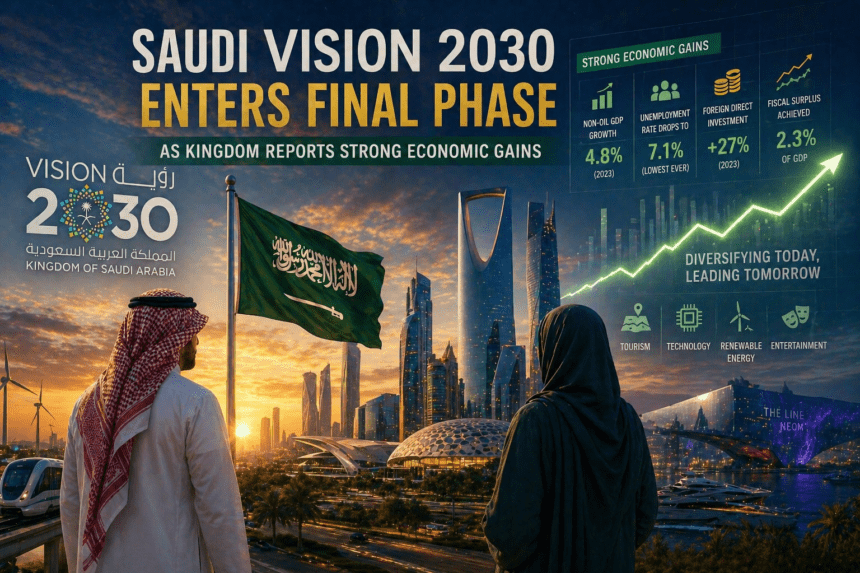
Saudi Arabia says Vision 2030 has entered its final phase, presenting the next few years as the stretch in which earlier reforms are meant to turn into full-scale delivery. In its latest official summary, the Kingdom described 2026 as the start of the program’s third and final phase, shifting the emphasis from rollout and institutional change toward execution, measurable outcomes and long-term impact.
The government is pairing that message with strong economic numbers. Official reporting says Saudi Arabia’s real GDP grew 4.5% in 2025, while non-oil activities expanded 4.9%, figures the authorities are using to argue that diversification is no longer just a slogan attached to Vision 2030 but an economic trend with visible weight.
That matters because Vision 2030 was always bigger than a reform brochure. It was launched to reduce the country’s dependence on oil, expand private-sector activity, raise non-oil revenues, and remake the economy through investment, tourism, logistics, technology, mining and large-scale urban projects. The final phase, at least on paper, is where the program either proves it can lock those changes in or begins to show where the limits are.
Saudi official reporting has also stressed that a large majority of Vision 2030 performance indicators have either been fully met or are progressing in line with targets. That gives Riyadh room to frame the current moment as one of confidence rather than correction. Still, the pressure is different now. Early phases are often about launching initiatives and building momentum. Final phases invite tougher questions: which reforms have changed the real economy, which gains are durable, and how much of the transformation can outlast oil price cycles?
The strongest part of the Saudi case right now is the non-oil story. Growth in non-oil activities has become one of the central benchmarks for whether the Vision is actually changing the structure of the economy. Officials say those sectors have continued to expand alongside investment and labor-market reforms, helping the government argue that the economy is becoming broader and less exposed to crude alone.
Even so, the final phase is likely to be judged less by headline ambition and more by follow-through. Vision 2030 has never lacked scale. What matters now is whether the Kingdom can convert flagship plans into consistent employment gains, sustainable private-sector depth and a diversification model that keeps working even when energy markets swing. Saudi Arabia is entering the closing chapter of its most closely watched national transformation plan with momentum on its side. The harder task is turning that momentum into proof.