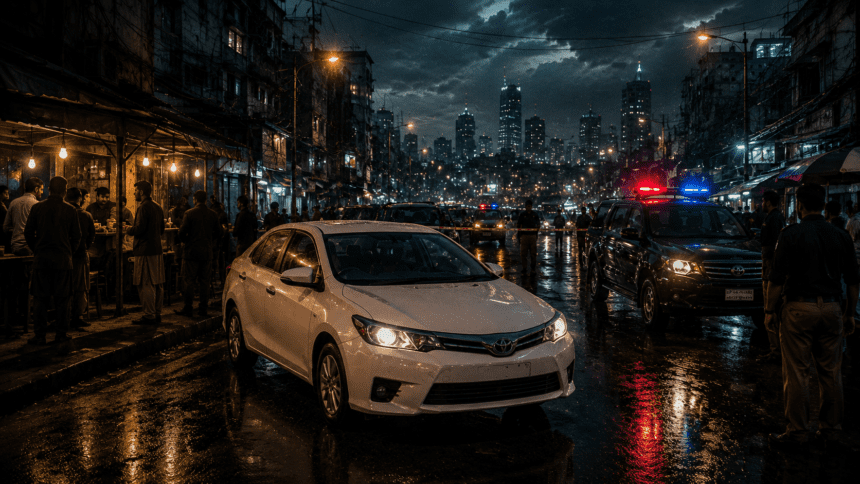
Karachi: For many Karachi residents, especially those living around DHA, Clifton and Sea View, the phrase “White Corolla Gang” still carries a grim memory. It wasn’t just the car. It was what people feared might happen when a white Toyota Corolla slowed down near them at night.
The case first gripped the city in 2008 and 2009, when police accused Mohammad Ali Hajano and his accomplice Umair Khan of using rented white Corollas, often with changed number plates, to carry out a string of robberies and violent attacks in Karachi’s affluent southern neighbourhoods.
What made the case especially chilling was not merely the number of offences, but the nature of the allegations. Reports linked the pair to robberies, rape allegations, attempted murder and other violent crimes. The accused were reportedly booked in dozens of cases, including rape and looting.
The fear spread quickly because the crimes were not unfolding in far-off, deserted places. They were happening in neighbourhoods many Karachiites associated with relative safety: DHA streets, Clifton roads, Sea View parking spots, areas where families, couples and young people often went out after dark. That contrast — familiar places turning suddenly unsafe — gave the case its lasting horror.
Police eventually arrested Hajano and Umair Khan in 2009 after multiple cases were registered at police stations in Karachi’s South Zone. Court proceedings later showed that several cases remained pending even after some convictions and acquittals.
The legal journey was messy, as high-profile criminal trials often are. In July 2015, a sessions court sentenced Hajano and Umair Khan to 15 years in two robbery cases involving houses in DHA. Both were also fined Rs25,000 each. Court officials said the accused had been acquitted in around half of the cases, while more than a dozen cases were still pending at the time.
Days later, the case took another major turn. A sessions court handed the two men a collective sentence of 45 years in three robbery cases. Separate reports also said Hajano and Umair Khan were sentenced in rape-related proceedings and fined Rs75,000 each.
Still, the story didn’t end neatly. Some cases collapsed. In 2016, Hajano and Umair Khan were acquitted in a Sea View robbery case after being cleared of charges of robbing a couple. That acquittal showed how difficult the prosecution of old, traumatic and evidence-heavy cases can become, especially when survivors and witnesses may be reluctant or unable to keep appearing in court.
Then came a startling reminder of the case’s afterlife. In October 2025, police arrested Mohammad Ali Hajano again in Karachi’s Gulistan-i-Jauhar after he allegedly looted a woman. Police confirmed he had previously been arrested and convicted, though it remained unclear whether he had been released on bail, acquitted in some matters or completed a sentence.
By then, “White Corolla Gang” had become more than a single case. It had turned into a Karachi crime label — one that resurfaced whenever robbers used a similar vehicle or method. In later years, other alleged gangs using white Corollas were also linked to house robberies, violent attacks and attempted robberies in different parts of the city.
That is perhaps why the saga still unsettles Karachi. It was not only about two men and a car. It exposed something deeper: how quickly fear can move through a city when criminals find a pattern, repeat it, and turn an everyday object into a warning sign.
For years, a white Corolla was just another common car on Karachi’s roads.
Then, for a while, it became a nightmare on wheels.