

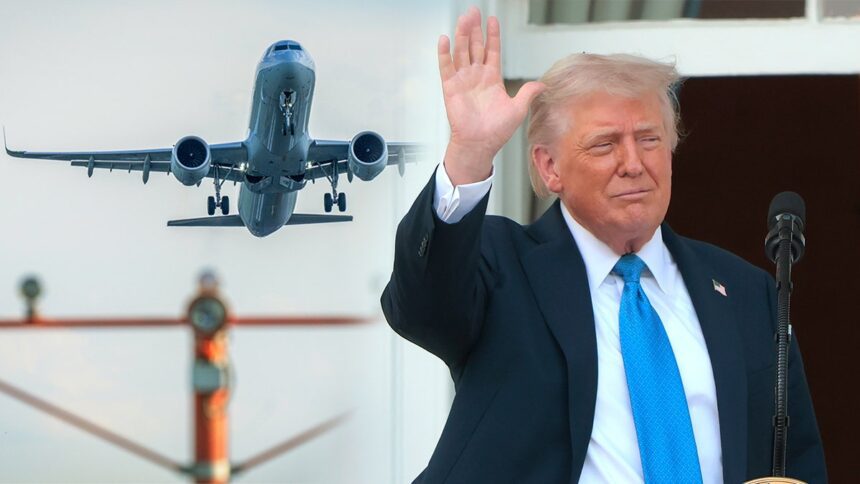
WASHINGTON: The Trump administration has proposed a new restriction that would bar Chinese airlines from flying over Russian airspace on routes to and from the United States, claiming the practice gives them an unfair competitive advantage over American carriers.
The U.S. Department of Transportation announced the proposal on Thursday, saying that by flying over Russia, Chinese airlines save flight time, burn less fuel, and cut operating costs benefits U.S. airlines cannot access due to Russia’s airspace ban on Western carriers.
Russia closed its skies to U.S. and several other foreign airlines in response to Washington’s 2022 ban on Russian flights following the invasion of Ukraine. However, Chinese carriers were exempted, allowing them to strengthen their market share on international routes.
According to the Transportation Department, this situation has created “substantial adverse competitive effects” on U.S. airlines, calling it “unfair.” The new proposal would apply these overflight restrictions to foreign air carrier permits issued by the U.S., though it excludes cargo-only flights.
China’s foreign ministry responded on Friday, saying such restrictions would harm “people to people exchanges.” The decision, if finalized, could impact major Chinese airlines including Air China, China Eastern, China Southern, and Xiamen Airlines.
Hong Kong-based Cathay Pacific, which reportedly still flies over Russia on routes such as New York to Hong Kong, was not mentioned in the proposal and declined to comment.
Shares of China’s top three state-owned airlines fell slightly following the announcement China Southern dropped 1.3%, Air China 1.26%, and China Eastern 0.95%. The carriers, still struggling to recover from five consecutive years of losses since the COVID-19 pandemic, now face new uncertainty.
This move adds another layer of strain to the already tense U.S.-China trade relationship. It also coincides with reports that Boeing is in talks to sell up to 500 aircraft to China a potential breakthrough in the world’s second-largest aviation market after years of stalled orders.
President Donald Trump and Chinese President Xi Jinping are expected to meet later this month in South Korea to discuss economic and diplomatic matters. Meanwhile, Chinese airlines have been given two days to respond to the U.S. proposal, with the final order possibly taking effect as early as November.
Before the pandemic, both countries operated more than 150 weekly round-trip passenger flights. That number drastically declined after 2020, with the U.S. approving only limited new routes last year but only for Chinese carriers that agreed to avoid Russian airspace.
U.S. airlines have argued that avoiding Russian airspace makes East Coast–China routes longer, more expensive, and sometimes unviable forcing them to reduce passengers and cargo loads to maintain safety and efficiency.
The proposed ban marks another flashpoint in a deepening aviation and trade dispute between Washington and Beijing, signaling that air travel has become the newest battleground in global economic rivalry.