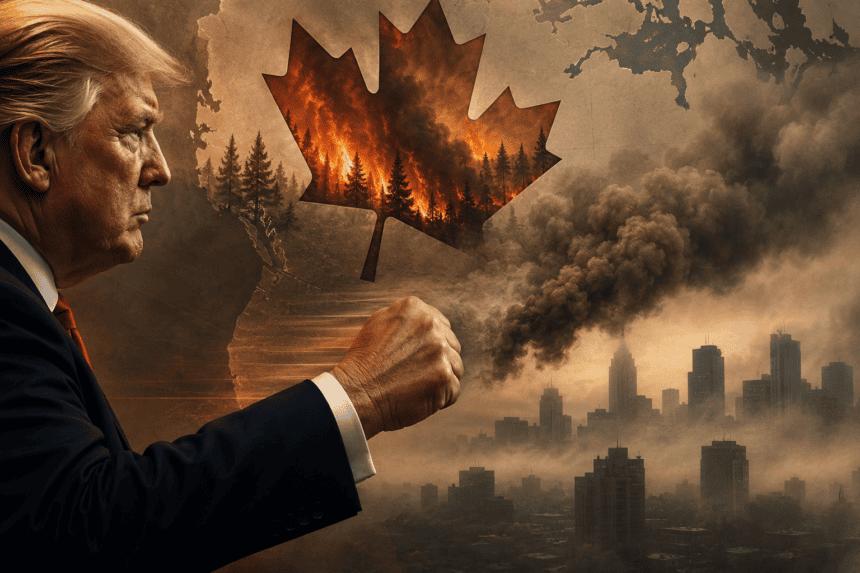
Donald Trump is threatening to impose heavy tariffs on Canadian goods, citing the “uncontrollable” flow of wildfire smoke that has blanketed several northern U.S. cities in recent months. The former president, currently campaigning for the 2024 election, framed the environmental issue as a trade and border security failure during a rally in Michigan on Tuesday.
“We have smoke coming down from Canada like a massive wall,” Trump told the crowd. “They aren’t managing their forests, and we’re paying the price in our lungs. If they can’t keep their air clean, we’ll make them pay at the border.”
The proposal marks a sharp escalation in how the U.S. approaches transboundary environmental issues. While past disputes between Washington and Ottawa have focused on lumber, dairy, or energy exports, linking air quality to trade policy is a departure from traditional diplomatic norms.
Public health officials in states like Minnesota, Wisconsin, and New York have recorded hazardous air quality levels repeatedly this year. The smoke, stemming from record-breaking wildfires in Quebec and Alberta, has forced schools to cancel outdoor activities and prompted warnings for vulnerable residents to stay indoors.
Economic analysts are already questioning the feasibility of the threat. Tariffs are typically applied to physical goods entering a customs territory, not to atmospheric conditions or weather patterns.
“You can’t slap a tax on a wind current,” said Sarah Jenkins, a trade policy researcher. “Tariffs are a blunt instrument. Using them to address a climate phenomenon is legally and logistically uncharted territory.”
The Canadian government has yet to issue a formal response to the rhetoric. However, sources within the Canadian High Commission suggest Ottawa views the comments as political theater designed to appeal to domestic voters rather than a serious policy shift. Canadian officials have previously pointed to climate change—a global issue—as the primary driver behind the intensity of the fire seasons, rather than forestry mismanagement.
The U.S. and Canada share the longest undefended border in the world, with deeply integrated supply chains. A trade war triggered by environmental grievances could disrupt industries ranging from automotive manufacturing to agriculture, both of which rely heavily on duty-free cross-border movement.
For now, the threat remains campaign trail rhetoric. But for border-state residents who spent much of the summer behind air purifiers, the idea of turning an environmental crisis into a trade dispute signals a new, more volatile era in U.S.-Canada relations.